Getty Images/Newsweek Illustration

By Andrew Stanton
Reporter
0
Share
Newsweek is a Trust Project member
See more of our trusted coverage when you search.Prefer Newsweek on Googleto see more of our trusted coverage when you search.
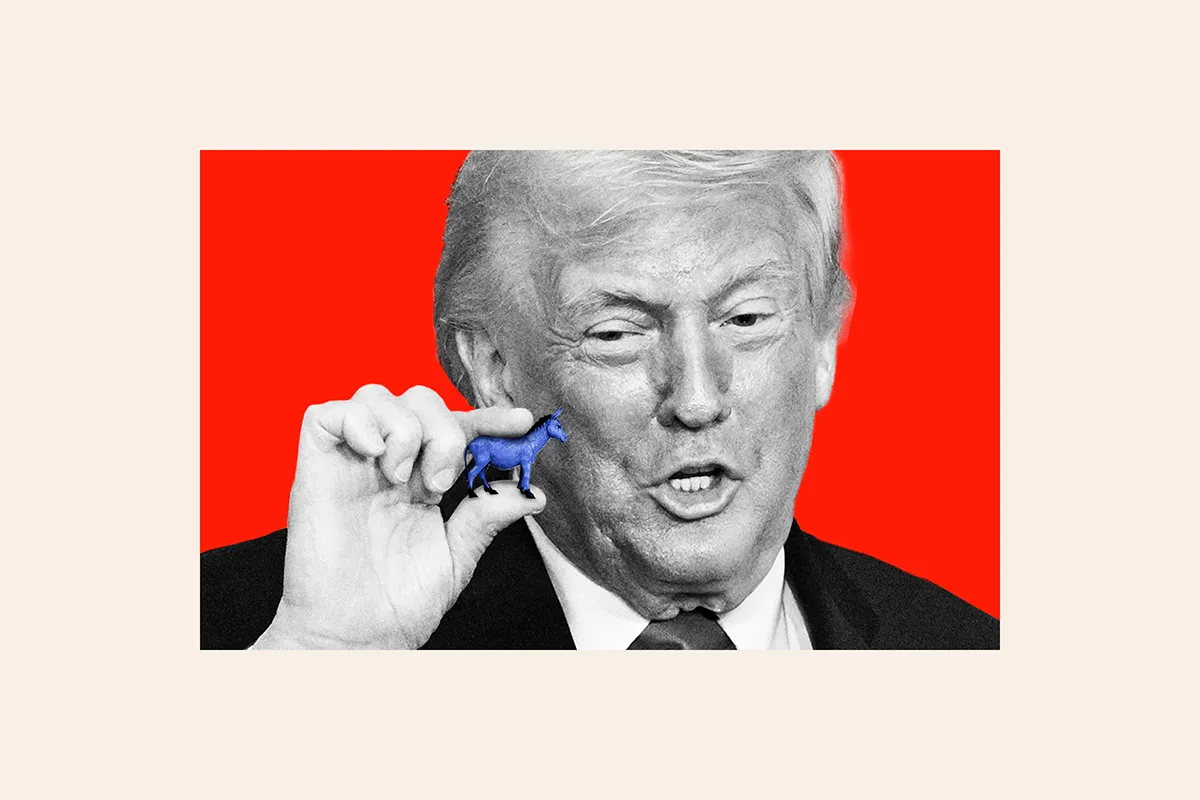
Even as President Donald Trump’s approval rating has slipped, recent polls show that many Americans still view him more favorably than the Democratic Party.
Newsweek reached out to the Democratic National Committee (DNC) and Republican National Committee (RNC) for comment via email.
Why It Matters
These polls could be a red flag for Democrats about how voters view the party and its leadership as it approaches the 2026 midterm elections, when members hope to reclaim control of the House and Senate.
Read More on Politics
Donald Trump vs. Democrats: What Polls Show
Recent polls show most Americans view Trump, the Democratic Party and the Republican Party all unfavorably. But the recent polling averages at RealClearPolitics deliver a warning sign for Democrats about their favorability.
Democrats’ net favorability rating stood at -20.4 points on Tuesday, with an average of 55.7 percent of Americans viewing the party unfavorably; compared to an average of 35.3 percent of Americans viewing the party favorably.
But Trump’s approval rating stood at -15.5 points, with an average of 56.6 percent disapproving of his job performance and 41.1 percent approving of the president.
A recent Quinnipiac University poll backs up those polling averages. Across all Americans, Trump’s approval rating was -18 points. Democrats’ favorability was -25 points. The poll surveyed 1,191 registered voters from March 19-23, 2026 and had a margin of error of plus or minus 3.6 percentage points.
Getty Images/Newsweek Illustration
The poll found that independent voters are more positive toward Democrats. Trump’s approval among independents stood at -43 points, while Democrats’ favorability among independents stood at -24 points.
Democrats’ problem is, in part, due to a relatively chilly favorability rating from their own voters, according to the poll. Democrats’ favorability among registered Democrats stood at +49 points, with 70 percent viewing the party favorably and 21 percent viewing it unfavorably.
For comparison, Republicans’ approval of Trump stood at +83 points, with 89 percent approving and only six percent disapproving.
A recent survey from Yahoo News and YouGov showed similar popularity for Trump and the Democrats. It gave Trump a -21 approval rating, with 59 percent disapproving and 38 percent approving of his job performance. Democrats’ favorability, meanwhile, stood at -22 points, with 57 percent viewing them unfavorably and 35 percent viewing them favorably.
That poll showed Trump holding up better among Republicans than Democrats among their own voters.
Trump’s approval among Republicans stood at +69 points, while Democrats’ favorability among Democrats stood at +65 points. Twenty-seven percent of independents said they approved of Trump, while 28 percent viewed Democrats favorably.
The poll surveyed 1,699 adults from March 12-16, 2026.
Both polls, however, did give Democrats a lead on the generic ballot for the midterms. In the Yahoo News/YouGov poll, Democrats led by four points (44 percent to 40 percent). Democrats led by 11 points in the Quinnipiac poll (51 percent to 40 percent).
Most polls across the board have given Democrats a lead.
There are other good signs for Democrats too, particularly special election victories. Democrats have been winning special elections in districts Trump carried in 2024—including the Florida legislative district that includes his Mar-a-Lago estate.
What’s Behind Democrats’ Polling Problem? Experts Weigh In
Democrats could be “taking some hits” from the Department of Homeland Security (DHS) shutdown in the short term but in the long run are still “struggling to present an alternative positive message and an alternative set of policies,” Grant Davis Reeher, professor of political science at Syracuse University, told Newsweek.
“Democrats have also, for the most part, decided to try to match a lot of the over-the-top rhetoric of President Trump, and that doesn’t serve them well. People want a fresher and less divisive alternative, and they’re not getting it from the Democrats.”
Reeher said Democrats will likely do well in the midterms but that there's a bigger concern for the 2028 election.
“I still think they’re positioned to do well in the midterms," he said. "You can get by there by just being opposed; 2028 will require more than that, however.”
Todd Belt, director of the Political Management Program at George Washington University, told Newsweek that Democrats have not been able to capitalize on Trump’s declining popularity as voters “are also very frustrated with their party's seeming inability to stand up to Trump.”
“Democratic leadership, especially in D.C., has been ineffective at stopping Trump," he said. "Secondly, Democrats haven't given voters anything to vote for, just being against Trump is not enough, especially when voters have voiced concerns about the economy, affordability and health care costs.”
Robert Y. Shapiro, professor of political science at Columbia University, told Newsweek that Democrats have “not offered a positive program in response to Trump's and the Republicans' efforts, and are basing their political efforts on the Trump administration's perceived deficient performance on multiple fronts.”
“In this period of polarized politics, the Democrats are hurt by the fact that the Republican base and other voters dislike them more than they dislike aspects of Trump and his administration,” he said.
Congressional Democrats Have Faced Voter Backlash in Trump 2.0 Era
Democrats have, at times, faced criticism from their own voters following Trump’s return to office. Over the first year of his second administration, many Democrats felt that their representatives in Washington, D.C. were not fighting hard enough against his policies such as his hard-line approach to immigration.
Senate Minority Leader Chuck Schumer, a New York Democrat, for instance faced a tsunami of party backlash in March 2025 after he declined to block a Republican-led stopgap bill to avoid a government shutdown. Schumer and eight other Democrats voted in favor of a procedural motion to allow debate on the bill but ultimately voted against its passage. That vote, however, allowed it to pass the filibuster and become law, Democratic critics say.
Schumer may face a challenge to his leadership next year. Some Democratic Senate candidates such as Illinois Lieutenant Governor Juliana Stratton, who secured the party’s nomination in the Senate race earlier in March, have said they would not support Schumer as leader.
Democrats’ divisions have been on display in Senate primaries. While leadership has backed Governor Janet Mills in Maine and Representative Haley Stevens in Michigan, some polls show those candidates in potentially precarious positions against more progressive candidates such as Graham Platner in Maine or State Senator Mallory McMorrow in Michigan. These races could become a measure of whether Democratic voters are willing to stick with the establishment.
Cory Booker Issues Warning to Democrats
Senator Cory Booker, a New Jersey Democrat, addressed the friction between Democrats in D.C. and their voters during an interview on NBC News’ Meet the Press over the weekend.
"I’m proud of so many things that my Democratic colleagues are doing, but as a whole, our party has failed this moment. It’s why I’ve called for new leadership in America. I’ve called for a generational renewal, because this left-right divide is killing our country, and our adversaries know it," he said.
Democrats have taken steps to address their popularity problem, with the DNC unveiling a new Organizing and Political Playbook designed to help boost the party in the midterms, Newsweek previously reported. The playbook lays out its recommendations in three categories: incorporating new voter contact methods, prioritizing ongoing relationships with voters, and redesigning the day-to-day work of organizers
What People Are Saying
RNC National Press Secretary Kiersten Pels told Newsweek: “President Trump is lowering drug prices, securing the border and putting more money back in Americans’ pockets. Democrats have voted to defund DHS seven times, triggering airport chaos and undermining TSA operations. It is no surprise 73 percent of voters disapprove of Democrats.“
Pollster Nate Silver, in a March 30 Substack post: "So far, however poor, Trump’s approval ratings remain within the range of other recent presidencies. Biden bottomed out at a -20.5 on July 4, 2024 (after his debate with Trump but before he dropped out). Trump’s first-term low was -20.8 on Aug. 6, 2017; he also hit a -19.1 a week or two after the events of January 6, 2021. Even Obama had some rough stretches, hitting his all-time low of -13.2 on Nov. 18, 2013."
CNN data analyst Harry Enten, on X on Monday: "House GOP knows trouble's brewing. A record 36 House GOP retirements so far. Why are they leaving? Just 40% approve of Trump. When pres[ident] approval is under 50% in midterms…Pres[ident] party avg. loss is 34 seats. The Smallest loss? 9 seats. Dems get a majority with a pickup of 3."
What Happens Next
Polling will continue to be tracked as a key measure of where the electorate stands ahead of the 2026 midterms on November 3. The extent to which the polls could signal turnout or enthusiasm concerns for Democrats remains to be seen.
Update 3/31/26, 1:34 p.m. ET: This article was updated with additional information.
View 0 Comments
Submit Correction
View Editorial & AI Guidelines