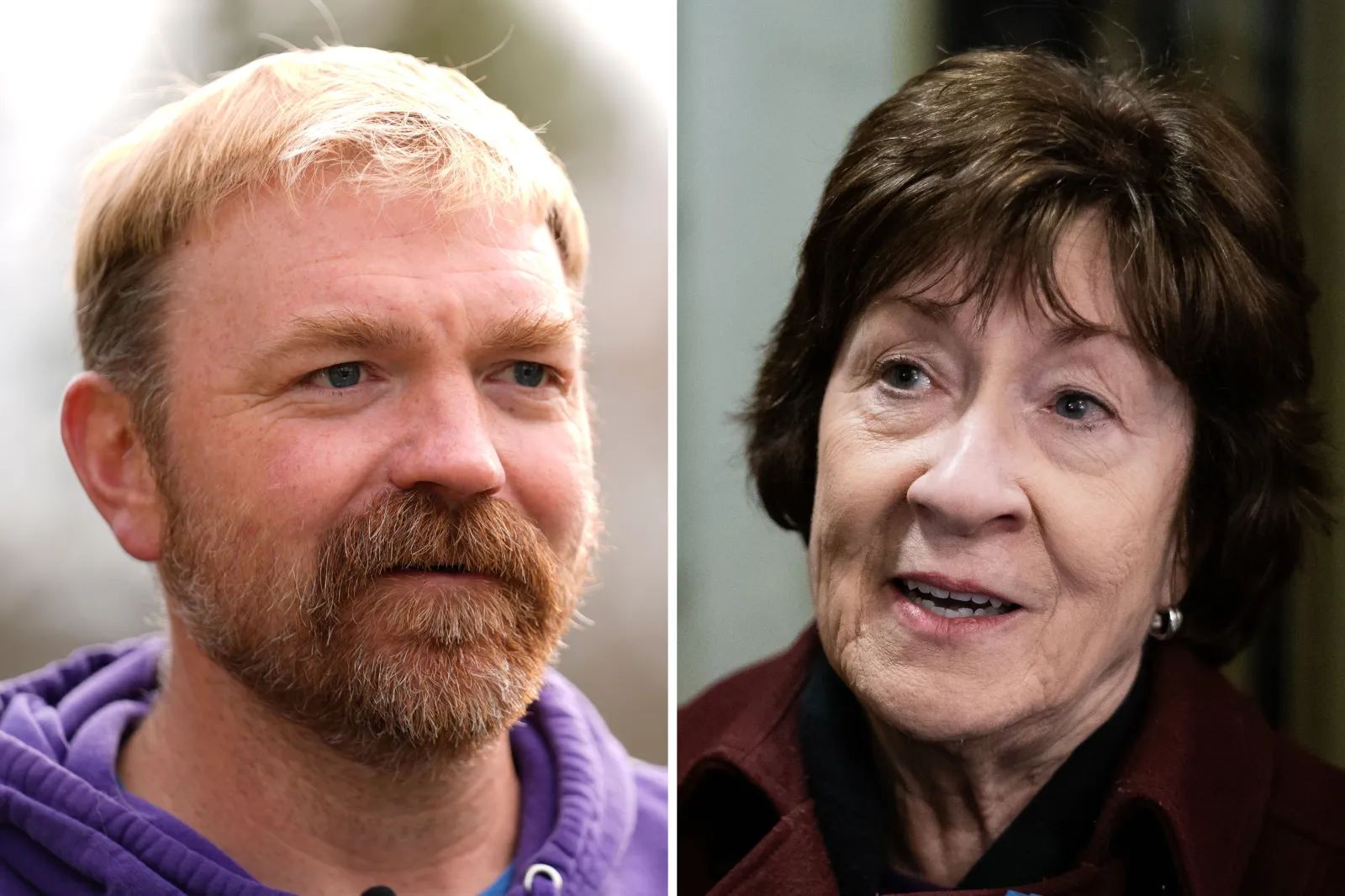
Robert F. Bukaty/Francis Chung/POLITICO/AP


By Matthew Robinson and Sam Stevenson
0
Share
Newsweek is a Trust Project member
See more of our trusted coverage when you search.Prefer Newsweek on Googleto see more of our trusted coverage when you search.
Two Democratic candidates are leading Republican Senator Susan Collins in Maine's Senate race ahead of the midterm elections, according to a new poll.
Why It Matters
Collins has long been one of the GOP’s most resilient incumbents, surviving multiple election cycles in a state that often leans Democratic at the presidential level.
Read More on Politics
Early polling showing two Democrats ahead underscores how competitive the 2026 race could become as control of the Senate hangs in the balance.
...
What To Know
The survey, conducted by Emerson College Polling between March 21 and 23, revealed that Democrats Graham Platner and Governor Janet Mills are both ahead of Collins.
In a hypothetical matchup, Platner leads Collins on 48 percent of the vote to 41 percent, with roughly 12 percent supporting someone else or still undecided.
Meanwhile, Mills leads Collins on 46 percent to 43 percent, with eight percent supporting another candidate and three percent undecided.
The poll was conducted on 1,075 likely Maine voters, and had a margin of error of plus or minus 2.9 percent.
The findings come from the first Emerson College Polling survey of the 2026 U.S. Senate race in Maine, offering an early snapshot of a contest that is expected to draw national attention.
Collins, who has represented Maine in the Senate since 1997, is seeking another term as Democrats look to expand their narrow Senate margins.
- ESSENTIAL READING: 5 Reasons Democrats Should Stop Writing Off Trump
- How US Allies Got Revenge After 70 Years
The same survey also tested the Democratic primary field, where oyster farmer Platner emerged with a commanding lead over Governor Mills. Platner led Mills by a wide margin, 55 percent to 28 percent, with 13 percent of Democratic voters undecided.
According to Emerson, that advantage sits well outside the poll’s margin of error.
Spencer Kimball, executive director of Emerson College Polling, said Platner’s support is especially strong among male voters, while women voters also favor him by a sizable margin.
“Platner has a significant lead over Governor Mills, which is outside the poll’s margin of error,” Kimbal said. “Male voters support Platner by a 41-point margin, 63 percent to 22 percent, while women support Platner by an 18-point margin, 50 percent to 32 percent.”
The results suggest a primary contest that may be taking shape earlier than expected, even with months to go before voting begins.
Beyond head‑to‑head matchups, the poll also measured candidate favorability, an indicator of broader political standing.
A majority of Maine voters, 57 percent, reported an unfavorable view of Collins, compared with 38 percent who view her favorably. Five percent said they were neutral.
Governor Mills also faces headwinds, with 54 percent holding an unfavorable view of her and 40 percent expressing a favorable opinion.
Platner’s profile appears more mixed but less defined, with 42 percent viewing him favorably, 38 percent unfavorably, and a combined 20 percent either neutral or unfamiliar with him.
Independent voters, a key bloc in Maine politics, showed particularly sharp disapproval of Collins, giving her a net unfavorable rating of 30 points.
Platner, by contrast, held a small net favorable rating among independents, while Mills posted a modest net unfavorable score.
What People Are Saying
Launching her campaign in February, Collins said: "True leaders bring both sides together to seek common ground not shout the loudest or seek the most social media clicks.”
Mills said in a statement last month: “Seniority without a backbone is just tenure and after decades in Washington, Senator Collins has failed to demonstrate the leadership required in this dangerous moment in history.
“As Donald Trump tramples on the Constitution, undermines the rule of law, and weaponizes the federal government against the American people, Susan Collins is refusing to stand up to his abuses and is instead rubber stamping a Republican agenda that prioritizes the wants of the wealthy over the needs of working Maine people.”
Platner said in a statement last month: “In November, the movement we are building will turn the page not just on Senator Susan Collins but also on her politics of hollow promises, acquiescence to Donald Trump, and failed leadership that’s made her and her friends richer but has sold out the rest of us. We will deliver this seat back to the people of Maine.”
What Happens Next
With the primary field beginning to solidify, attention is expected to shift toward fundraising, campaign messaging, and voter outreach across Maine.
National party committees and outside groups are also likely to monitor the race closely as it develops into one of the most closely watched Senate contests of the 2026 cycle.
Update: 03/26/26, 08:20 a.m. ET. This article has been updated with more information.
View 0 Comments
Submit Correction
View Editorial & AI Guidelines