...


By Hollie Silverman and Jesus Mesa
0
Share
Newsweek is a Trust Project member
See more of our trusted coverage when you search.Prefer Newsweek on Googleto see more of our trusted coverage when you search.
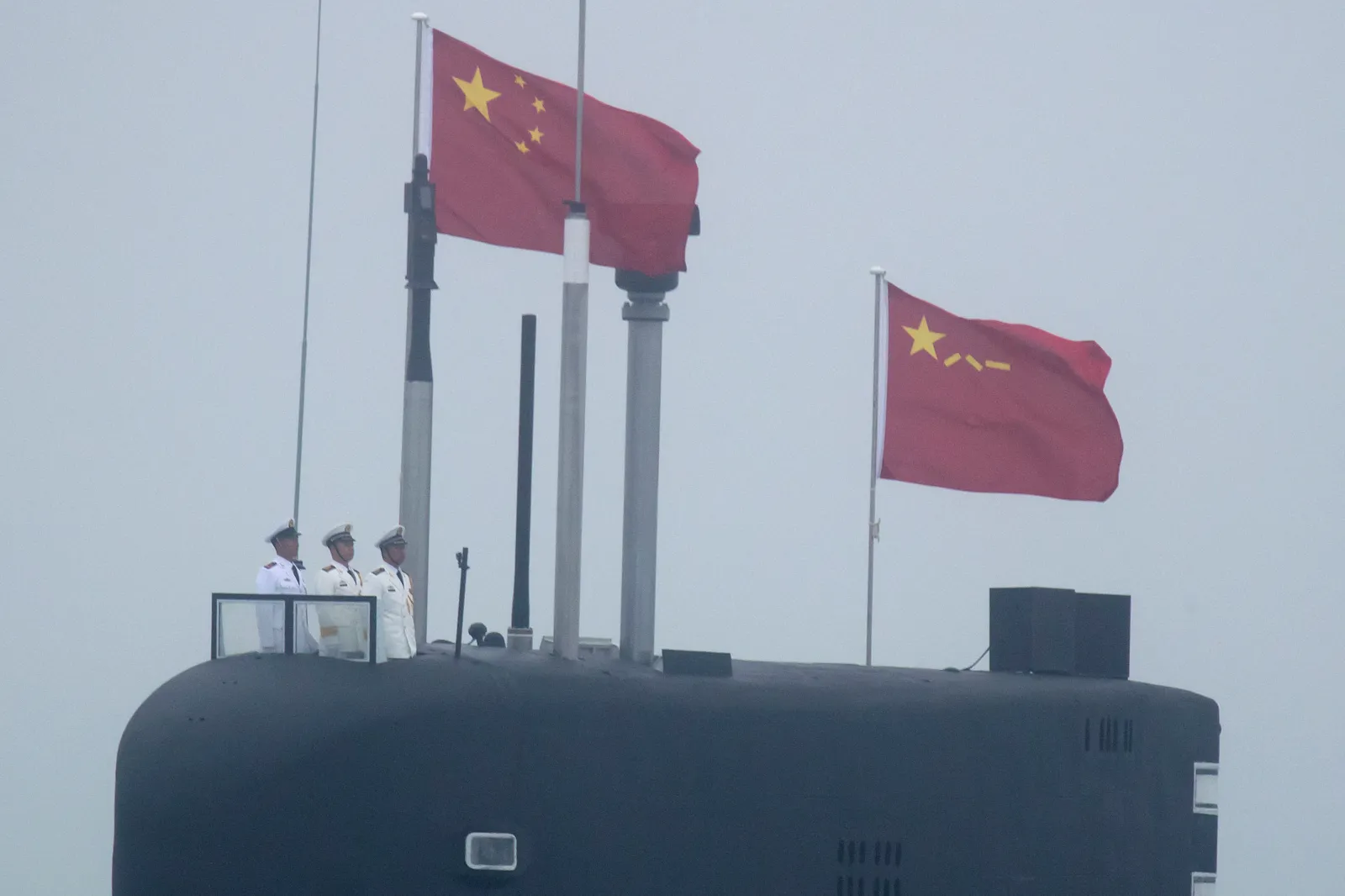
The head of the U.S. Navy issued a warning Monday about China's military capabilities following an uptick in production of more advanced submarines.
Rear Admiral Mike Brookes said in a statement to the U.S.-China Economic and Security Review Commission that the Chinese Navy has "dramatically increased” production and could soon strike "large portions" of the United States.
“These submarines will incorporate substantial advancements in nuclear reactor design, sensor performance, weapons integration, and noise quieting technologies,” Brookes said about two new Chinese submarines, the Type 095 and Type 096.
Read More on World
Brookes warned that the Type 096 “will be able to target large portions of the US from protected waters” near China’s coast.
Why It Matters
The announcement came on Monday as increased concern for nuclear capabilities unfolded due to U.S.-Israel military strikes in Iran and subsequent retaliatory strikes throughout the Middle East.
Over the past year, the Chinese navy has made significant advances in shipbuilding and force projection, from commissioning its most advanced aircraft carrier, CNS Fujian, to conducting two notable, distant deployments in the broader western Pacific and around Australia, showing it is increasingly capable of challenging America's naval supremacy.
What To Know
Washington’s warning, first reported by Bloomberg, reflects growing concern over the rapid modernization of China’s sea-based nuclear forces, a critical leg of its nuclear triad. U.S. defense officials have increasingly emphasized not just quantity, but quality, especially improvements in stealth, reactor efficiency and missile range.
According to Brookes, long-term infrastructure investments at China’s three main shipyards, some dating back to 2010, have more than doubled submarine production capacity. Annual output has increased from fewer than one nuclear submarine per year to significantly higher production rates, he said. Those investments, initiated more than a decade ago, position the PLA Navy for sustained expansion through the 2030s, Brookes said.
China’s submarine fleet is projected to reach roughly 70 boats by next year and could expand to as many as 80 by 2035. About half are expected to be nuclear-powered, marking a significant shift in the force’s composition.
...
Fleet Comparison
The People’s Liberation Army Navy currently operates more than 60 submarines, including roughly 50 diesel-electric boats, alongside a smaller but expanding fleet of nuclear-powered vessels. Among its most capable attack submarines is the Shang III-class, a nuclear-powered platform designed to conduct anti-ship and land-attack cruise-missile strikes while operating at reduced noise levels.
At least six of the expected eight Shang III boats have launched since 2022. Separately, China maintains six Jin-class ballistic missile submarines capable of carrying intercontinental ballistic missiles that could reach the United States from patrol areas deeper in the Pacific.
By comparison, the U.S. Navy fields 71 submarines, including 12 Ohio-class ballistic missile submarines, attack submarines armed with torpedoes and Tomahawk missiles, and four guided-missile submarines designed to carry large payloads and special operations forces.
Randall Shriver, chairman of the U.S.-China Economic and Security Review Commission, warned that although the U.S. retains “significant advantages in the underwater domain,” those advantages could erode if not maintained.
What People Are Saying
Rear Admiral Mike Brookes, a senior U.S. Navy intelligence official, said in a statement submitted to the U.S.-China Economic and Security Review Commission: “These investments, initiated as early as 2010, have more than doubled China’s submarine production capacity and position the PLA Navy for sustained force expansion through the 2030s and beyond.”
Commission Chairman Randall Shriver said in his opening remarks: “China is advancing a growing fleet of increasingly capable submarines, unmanned underwater vehicles, seabed sensors and sophisticated oceanographic mapping programs.”
What Happens Next
The Type 095 and Type 096 submarines are expected to enter service in the late 2020s and into the 2030s. While China’s fleet is expanding rapidly, the U.S. submarine industrial base has struggled with workforce shortages and delivery delays affecting the Virginia-class attack submarine and Columbia-class ballistic missile submarine programs.
Update 3/2/26, 12:50 p.m. ET: This article was updated with additional information.
In a polarized era, the center is dismissed as bland. At Newsweek, ours is different: The Courageous Center—it's not "both sides," it's sharp, challenging and alive with ideas. We follow facts, not factions. If that sounds like the kind of journalism you want to see thrive, we need you.
When you become a Newsweek Member, you support a mission to keep the center strong and vibrant. Members enjoy: Ad-free browsing, exclusive content and editor conversations. Help keep the center courageous. Join today.


View 0 Comments
Submit Correction
View Editorial & AI Guidelines