10
Loading video...

By Micah McCartney
Reporter
0
Share
Newsweek is a Trust Project member
See more of our trusted coverage when you search.Prefer Newsweek on Googleto see more of our trusted coverage when you search.
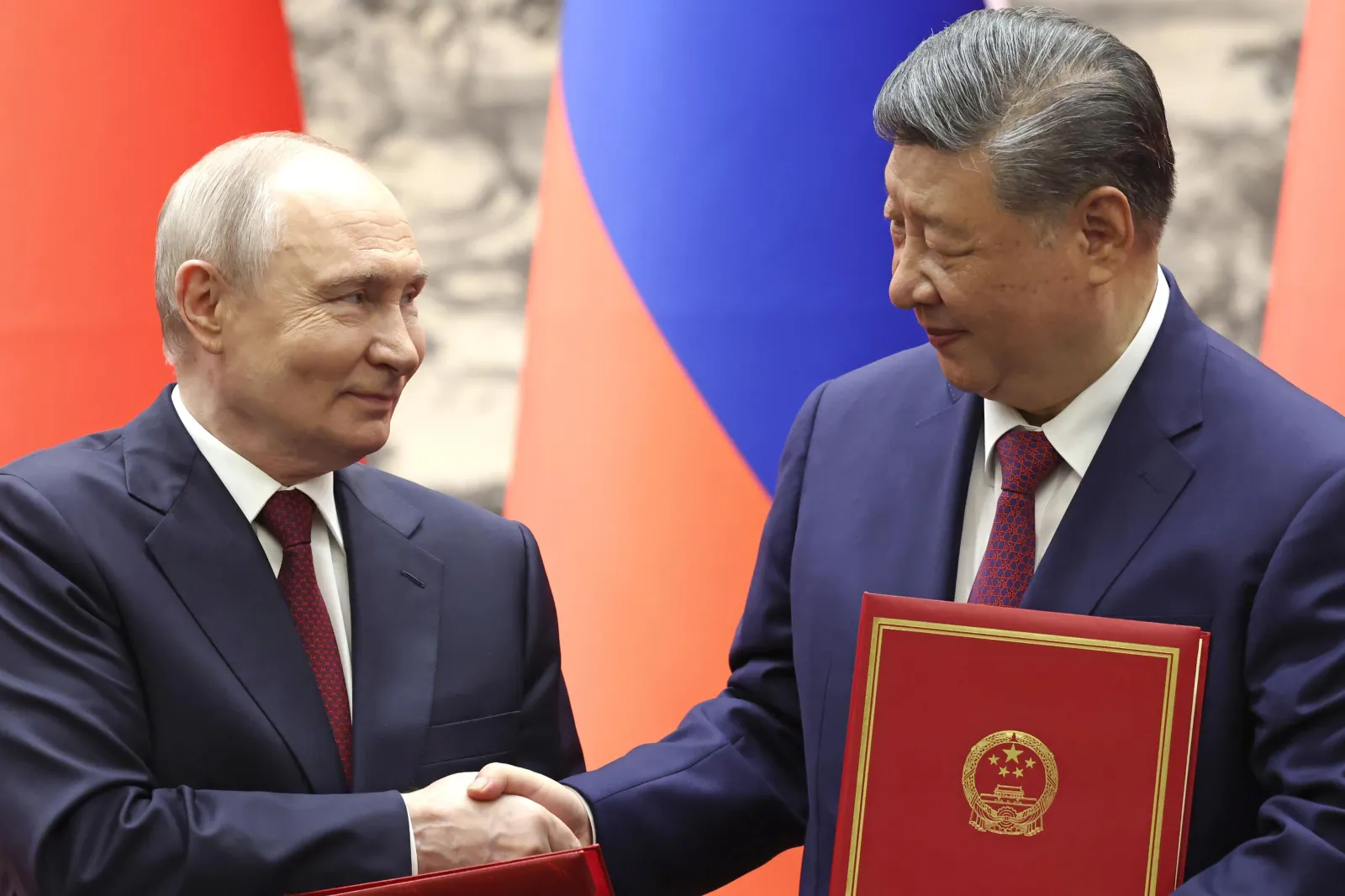
The United States loomed large over a high-level summit between Russian President Vladimir Putin and Chinese leader Xi Jinping in Beijing on Wednesday.
Putin's 25th visit to China in his more than two decades at the top of the Russian government came at a critical time as his war against Ukraine entered its fifth year. For Xi, the visit of another world leader so soon after President Donald Trump presented the perfect platform to demonstrate China’s growing influence on global affairs.
"Today, unilateralism and hegemonic aspirations are rampant, with chaos reigning supreme in international affairs," Xi said, according to a Kremlin readout, in a clear reference to the United States.
Read More on World
Xi and Putin criticized U.S. nuclear policy as well as Trump's plan for a "golden dome" space-and ground-based missile interceptor system, calling the plans irresponsible and a threat to global stability.
As "great world powers" and permanent members of the United Nations Security Council, China and Russia must pursue their "long-term interests in achieving national revival" by further deepening strategic cooperation and "building a just and smart global system of governance," Xi said.
The two sides approved more than 20 agreements to bolster people-to-people ties, from tech to extending China's visa-free policy on Russian arrivals. They did not, however, clinch a deal on a key item on Putin's wish list—the Power of Siberia 2 pipeline, a long-delayed joint project whose gas revenues could give Russia's slowing economy a significant boost.
"China is happy to prop up the Russian economy, but is aware that this pipeline is far more advantageous to Russia, rather than China who already has adequate supply of gas and is transitioning to a green model," Callum Fraser, a research analyst on international security with the London-based Royal United Services Institute think tank, told Newsweek.
Xi hosted "longtime friend" Putin in the Great Hall of the People, the site of Xi's summit with Trump last Thursday. The Russian president departed Beijing on Wednesday evening local time.
How Xi Welcomed Trump and Putin
Although Trump and Putin both received lavish welcomes—honor guards, gun salutes and cheering children—there were still clear differences in how Xi handled the two visits.
Xi hosted Trump first, before welcoming Putin days later, putting the U.S. visit at the front end of a week of high‑level diplomacy in Beijing. Xi spent many more hours with Trump, including at the secretive Communist Party compound known as Zhongnanhai, with the U.S. president’s schedule including a state banquet on day two and tea and lunch on day three.
There were also differences at the level of protocol. Trump stepped off Air Force One to be met by Chinese Vice President Han Zheng, while Foreign Minister Wang Yi greeted Putin.


...
Russian media hyped up the warm reception Putin received. Moscow city government‑owned newspaper Argumenty i Fakty ran the headline: “A great friend: the Chinese greeted Putin.”
While Wang is formally lower in rank than Han, he is considered more influential in elite politics because he is a sitting member of the Politburo, the Chinese Communist Party's top decision-making body, the outlet observed.
Yet it is not the pomp that matters but the content, Kremlin spokesman Dmitry Peskov told the media. “It is not always easy to compare the content, as not everything is shown on the surface. However, the main value lies in the content, not in the ceremonial aspects."
The public messaging from each president differed. Trump emphasized potential deals, while statements around Putin’s visit focused on “strategic partnership,” coordination and energy ties.
The composition of their business delegations also was different. Trump arrived with more than 20 U.S. corporate heavyweights at his back, including Apple’s Tim Cook, Nvidia’s Jensen Huang and Tesla’s Elon Musk. Putin’s business entourage, by contrast, was weighted toward energy and banking—the backbone of Russia‑China trade ties—including Gazprom CEO Alexei Miller and VTB chief Andrei Kostin.
Putin's visit was anchored by the annual China‑Russia Expo in China’s northeastern Heilongjiang province on the Russian border, drawing more than 1,500 companies, with Russian firms heavily represented.
“That appears to be a rather more pragmatic and probably deeper trade relationship than 20 U.S. CEOs turning up,” a representative of Russia’s Pivot to Asia project said.
Putin Peddles Russia’s Fossil Fuels
Economic ties were a major item on Putin’s agenda. While Xi, in his opening remarks, repeated calls for an early end to the Iran war to "help reduce disruptions to energy supply stability," Putin told Xi that Russia would continue to be "a reliable supplier of resources" amid the conflict in the Middle East.
China became Russia's top trading partner and the largest buyer of its oil and gas after the Ukraine war began, providing an economic lifeline to weather the international sanctions meant to hobble Russia's economy over the invasion.
Bilateral trade hit record highs in 2023 and 2024 and remained strong last year, totaling $228 billion—a more than 60 percent increase since 2021.
Much of that growth has been driven by China’s purchases of discounted Russian oil and natural gas, which have dominated Russia’s exports to China since the war began.
China may increase imports of Russian oil and gas if the U.S. and Iran fail to reach an agreement to reopen the Strait of Hormuz, through which China sources more than 40 percent of its oil imports and one-third of its gas imports.
When it comes to oil, China enjoys considerable buffers—the world's largest strategic reserves, heavy investments in green energy, and alternate suppliers, chiefly Russia.
America may soon become another source, according to Trump, who told reporters Xi was interested in buying American oil and gas as China seeks to diversify away from the Middle East choke point. Such a move could further erode Putin's leverage, which analysts say has shifted somewhat more in his favor because of the ongoing oil shock.
Beijing has not confirmed the possible purchases of American crude and gas. China halted its modest imports of U.S. oil in 2025 in retaliation for Trump's tariffs.
Putin and Xi Remain Closely Aligned
Russia's partnership with China has in recent years steadily deepened, and the two have aligned their messaging in their calls for a more stable, multipolar alternative to the U.S.‑led global order.
Putin has been a "key driving force" behind this partnership and the current round of talks, said Hu Xijin, former editor of China’s nationalist tabloid the Global Times and a prominent political commentator with nearly 25 million followers on the microblogging site Weibo.
He wrote on the Chinese social media platform that Putin's visit "will further strengthen the strategic relationship between the two countries, is of great significance for consolidating their respective diplomatic strategies, and carries global significance."
China-Russia ties have deepened since both countries announced a "no-limits partnership" on the eve of the Ukraine war. Since then, they have anlso expanded joint military drills in the Pacific. And while China has called for a negotiated peace deal in Ukraine, it has repeated the Kremlin's narrative faulting the expansion of NATO membership for the conflict.
Chinese firms have aided Russia's military industry materially, through exports of electronics, machineryand other dual‑use goods, U.S. and European officials say, with NATO going so far as to label China a "decisive enabler" in 2024. Beijing has denied providing military support and says it does not export weapons to either side.
Russia's dependence on its neighbor, however, has raised concerns among some of Putin’s allies that Russia has been relegated to the role of a junior partner.
Putin's visit became a top trending topic on Chinese social media on Tuesday, racking up more than 250 million views on the social media platform Weibo ahead of the Russian leader's arrival. Chinese social media operates under strict state control, with content subject to censorship and amplification by authorities, meaning trending topics can reflect both genuine public interest and official messaging priorities.
Center of 'Global Diplomacy'
China’s state media hailed the latest visit by Putin as proof of Beijing's central role in international affairs. The Global Times said the two high-profile trips showed Beijing to be "focal point of global diplomacy."
"The tightly sequenced visits have sparked widespread attention, with analysts noting that it is extremely rare in the post-Cold War era for a country to host the leaders of the U.S. and Russia back-to-back within a week,” the state-owned paper said.
Putin's trip is the latest in a string of visits to Beijing by international leaders this year, including British Prime Minister Keir Starmer, Spanish Prime Minister Pedro Sánchez, French President Emanuel Macron, German Chancellor Friedrich Merz and South Korean President Lee Jae-myun.
These leaders have sought warmer ties and trade deals with China amid strained relations with Washington following Trump’s sweeping "Liberation Day" tariffs and other moves that have unsettled longstanding allies, including his threat to control Greenland and remarks about making Canada a 51st state.
Canadian Prime Minister Mark Carney said during a visit to China in January that his talks with Xi were a recognition of a "new world order."
...
A 23-year-old student from China's Shanxi province told Reuters that the pair of visits by Trump and Putin demonstrated how far China had come as a global power.
"Previously, we were a developing country, and the global structure used to be one superpower with multiple major powers," she said. "But as our country has gradually developed, they have come to realize that China could potentially pose a challenge to them. That's why they're visiting China—to learn more about us and, at the same time, seek cooperative relationships."
Yet this succession of visits should not be mistaken as jumping onto the Chinese bandwagon quite yet, observers say.
"These visiting countries are primarily driven by their pursuit of practical cooperation with China amid current global uncertainties," Lye Liang Fook, an associate senior fellow at Singapore's ISEAS-Yusof Ishak Institute, told Newsweek.
"Going by Carney’s words, even though China and other countries may not see eye to eye on everything, they could still collaborate on specific issues when their interests coincide,” Lye said.
But other nations will be watching closely to see whether China's actions match its words, Lye said, noting that Beijing's calls for respect for the sovereignty of all countries appear inconsistent with its refusal to condemn Russia's invasion of Ukraine.
View 0 Comments
Submit Correction
View Editorial & AI Guidelines