
...

By Paul Bond
Chief Correspondent, Culture
0
Share
Newsweek is a Trust Project member
See more of our trusted coverage when you search.Prefer Newsweek on Googleto see more of our trusted coverage when you search.
The U.S. Supreme Court is expected to decide this month the fate of roughly 350 people convicted of or charged with obstruction for trespassing in and around the Capitol Building on January 6, 2021, while members of the House and Senate were certifying the vote count of the Electoral College.
The case, Fischer v. United States, is centered around the use of Section 1512(c)(2), enacted in the aftermath of the 2001 Enron accounting scandal and usually applied to destroying evidence and witness tampering, though the law also makes it a crime to otherwise obstruct, influence or impede any official proceeding.
The outcome will certainly affect the case against Donald Trump. Trump, the presumptive Republican presidential nominee was indicted on four counts, including 1512(c)(2), in August by Special Counsel Jack Smith stemming from his alleged role in the Capitol riot.
Read More on News
But as cameras follow Trump's every move, many far more anonymous Americans without the wealth and power of a former president are on pins and needles hoping the High Court sides with Joseph Fischer.
Section 1512(c)(2) in front of the Supreme Court
While anything involving Trump and January 6 is invariably politicized, Fritz Ulrich, one of the attorneys representing Fischer, hopes that will not be the case for the nine justices who will decide his client's fate—and that of hundreds more Trump supporters who attended the so-called "Stop the Steal" rally three-and-a-half years ago.
"In a statutory interpretation case like this, I'd like to think politics would play no role," said Ulrich. "January 6 was a unique event in U.S. history, so it's not fair to compare it to other occurrences. It just doesn't seem to those of us who have been working on the 1512(c) issue that this provision reached the conduct prosecutors were alleging."
According to court documents, Fischer, a police officer in Pennsylvania at the time, advanced about 25 feet into the Capitol and spent four minutes inside before exiting. Prosecutors note that he texted that members of Congress can't vote "if they can't breathe" and also that his police chief may need to post his bail because "it might get violent."
The FBI arrested Fischer in February 2021, and in November 2021 a grand jury charged him with seven felonies and misdemeanors, including 1512. In March 2022, District Judge Carl Nichols dismissed the 1512 obstruction charge against Fischer, who was represented by Ulrich's wife, Lori, but government prosecutors appealed and in April 2023 a panel for the District of Columbia Circuit reversed Nichol's ruling with Fritz Ulrich representing Fischer.
Fischer immediately appealed the reversal and in December the U.S. Supreme Court said it would take up the issue, with Jeffrey Green joining Ulrich on behalf of Fischer.
"My wife won and I lost, so, hopefully, the Supreme Court will restore some domestic tranquility to our household," Fritz Ulrich quipped.
"What Congress came up with in the wake of Enron," he continued, "was to include instances of document shredding and tampering with a witness. They were closing a loophole. The statute wasn't intended to have applications outside of those circumstances."
During oral arguments on April 16, Justice Neil Gorsuch asked Solicitor General Elizabeth Prelogar about the potential breadth of the statute under the government's interpretation, wondering if the section could also apply to a heckler in the Supreme Court gallery, to a sit-in at a trial or to someone who pulled a fire alarm before a congressional vote, as Democrat Congressman Jamaal Bowman did last year.
During oral arguments in the Supreme Court, Prelogar countered that Gorsuch's "hypotheticals" could be charged as obstruction if they were "meaningful" and had "corrupt intent."
Bowman was not charged with 1512 at that time for his actions. The congressman made an agreement with prosecutors to plead guilty to one misdemeanor, pay a $1,000 fine and write an apology letter.
Justice Brett Kavanaugh noted that Fischer had been indicted on six other counts and asked Prelogar why that wasn't "good enough," questioning if the 1512 charge was just a tool for increasing sentences for January 6 defendants. Prelogar said that one of Fischer's charges, assault, can carry a stiffer penalty than does 1512.
"I wouldn't say she scared us, or surprised us, but she's an exceptional oral advocate," Ulrich said of Prelogar.
Speaking on behalf of Fischer was Green, who argued that the government "wants to unleash" the potential of a 20-year sentence on peaceful protesters in violation of the First Amendment. He called such a scenario "a very serious tool to put in the hands of prosecutors," and said it was not the intention of 1512.
According to SCOTUSblog.com, Justice Elena Kagan was particularly resistant to Green's argument, writing that she stressed there are "multiple ways in which the drafters could have made clear that Section 1512(c)(2) only applies to evidence tampering – but they did not."
Ulrich also told Newsweek that his presumption is that rules associated with collateral review mean that the few who were sentenced for obstruction under 1512 more than a year ago won't benefit should Fischer win.
"It won't open the door for everyone who wants to get out of prison," he said. "But a lot of cases were stayed and held pending Fischer, so those men and women would go back to court and be resentenced."
Warnings and impacts of 1512 charges
Predictably, Fischer vs. United States has become a political football, with some conservatives warning that if the court sides with government prosecutors over Fischer it will set the stage for authorities to pick and choose which protesters should face prosecution and which should not, based on the political leanings of the demonstrators.
On February 5, Senator Tom Cotton and Congressman Jim Jordan filed a Supreme Court brief in support of Fischer that was signed by an additional 21 Republican members of the House and Senate.
"The Biden administration's pursuit of its political opponents must be stopped. Their strained interpretation of the law would criminalize vast swathes of everyday political conduct and violate the First Amendment," Cotton said when filing the brief.
"Congress never granted, and no administration should have the power to lock up political opponents for 20 years for merely trying to 'influence' Congress," Cotton said.
Conservatives have long suspected that the use of 1512 against Capitol rioters was more than coordinated, but nefarious, and on Tuesday the Wall Street Journal reported that Attorney General Merrick Garland and his team "spent hours gaming out how a law designed to tackle white-collar fraud could apply to the attack."
In testimony Tuesday during a House Judicial Committee hearing on a variety of topics, Republican Congressman Thomas Massie asked Garland: "Is your office preparing to drop charges against more than 340 January 6ers charged with 1512(c)(2) and release dozens from prison on that count if the Supreme Court this month reverses how your department has used that statute?"
Garland responded with, "Whatever the court rules, we will act appropriately. I don't answer hypotheticals; we'll wait and see what the Supreme Court says."
Among those who support the use of 1512 on J6ers is CREW, Citizens for Responsibility and Ethics in Washington, run by Noah Bookbinder, a former member of the Homeland Security Advisory Counsel who was appointed by Secretary Alejandro Mayorkas.
"Will the Supreme Court kneecap a key law used to prosecute insurrectionists?" CREW asked on its website in March. "The convictions of hundreds of January 6th defendants could be invalidated, causing a huge step backwards for accountability."
While defenders of 1512 support the 20-year sentence maximum it affords, no January 6 defendant has yet to receive such a penalty. In August, The Hill reported that Oath Keepers founder Stewart Rhodes received 18 years, the longest sentence thus far, but it's unknown what his penalty might have been without the 1512 charge given he was also convicted of seditious conspiracy, which also carries a 20-year sentence.
Hope for J6 participants
As the Supreme Court considers Fischer's fate, those charged with 1512 after the Capitol riot are holding out hope.
"They're praying, they're hoping, all of the above," said Joe Jenkins, whose girlfriend, Rachel Powell, is in a West Virginia prison where she has bonded with a half-dozen or so other January 6 defendants.
...
In a letter from prison, Powell complained about several aspects of her incarceration, especially noting that the Secure Female Facility Hazelton, where she'll serve nearly five years—though perhaps less if Fischer prevails—allows transgender inmates.
"The worst thing of all is women being forced to house with biological males," wrote Powell. "One woman was recently put into SHU (solitary confinement) after experiencing abuse from a male. Another was shipped off the compound after having sex with several women, some of them filing complaints. One young female inmate was given $300 worth of Suboxone to sleep with a biological male."
The Bureau of Prisons declined Newsweek's request for comment. Its guidelines stipulate that placement of transgender or intersex inmates are based on their "health and safety, and whether a placement would present management or security problems."
That January 6 defendants are having a rough time while incarcerated isn't surprising to Ulrich.
"Doing time in the Bureau of Prisons is beyond difficult. Most of these 'J6ers' don't have any prior experience, so it's no surprise that suddenly spending time in the BOP is a shock," Ulrich told Newsweek.
For his part, Trump has already signaled he'd pardon some January 6 defendants, including those who violated 1512, should he win the presidency in November.
Impact of overturning 1512
Beyond additional prison time, those convicted of 1512 also risk their ability to travel to foreign countries, to possess firearms, and their right to vote, depending on which state they live in.
Already, roughly 10 January 6 defendants have been released or will be while the Supreme Court decides the Fischer case. In March, for example, U.S. District Judge Trevor McFadden said Kevin Seefried, who strolled through the Capitol while carrying a Confederate flag, should be released after serving one year for misdemeanors.
But the judge said that prosecutors can revisit the additional two years he was sentenced to for his lone felony conviction—that being 1512—once the Supreme Court rules on Fischer.
There are presumptions, meanwhile, that some judges will seek to enhance sentences if Fischer is successful by dictating sentences on lesser crimes be served consecutively rather than concurrently, an issue addressed by Judge McFadden when he ordered the release of Seefried.
"The government is left to rely on the speculative claim that, without the felony conviction, the Court would convert Seefried's concurrent sentences to consecutive ones," McFadden wrote.
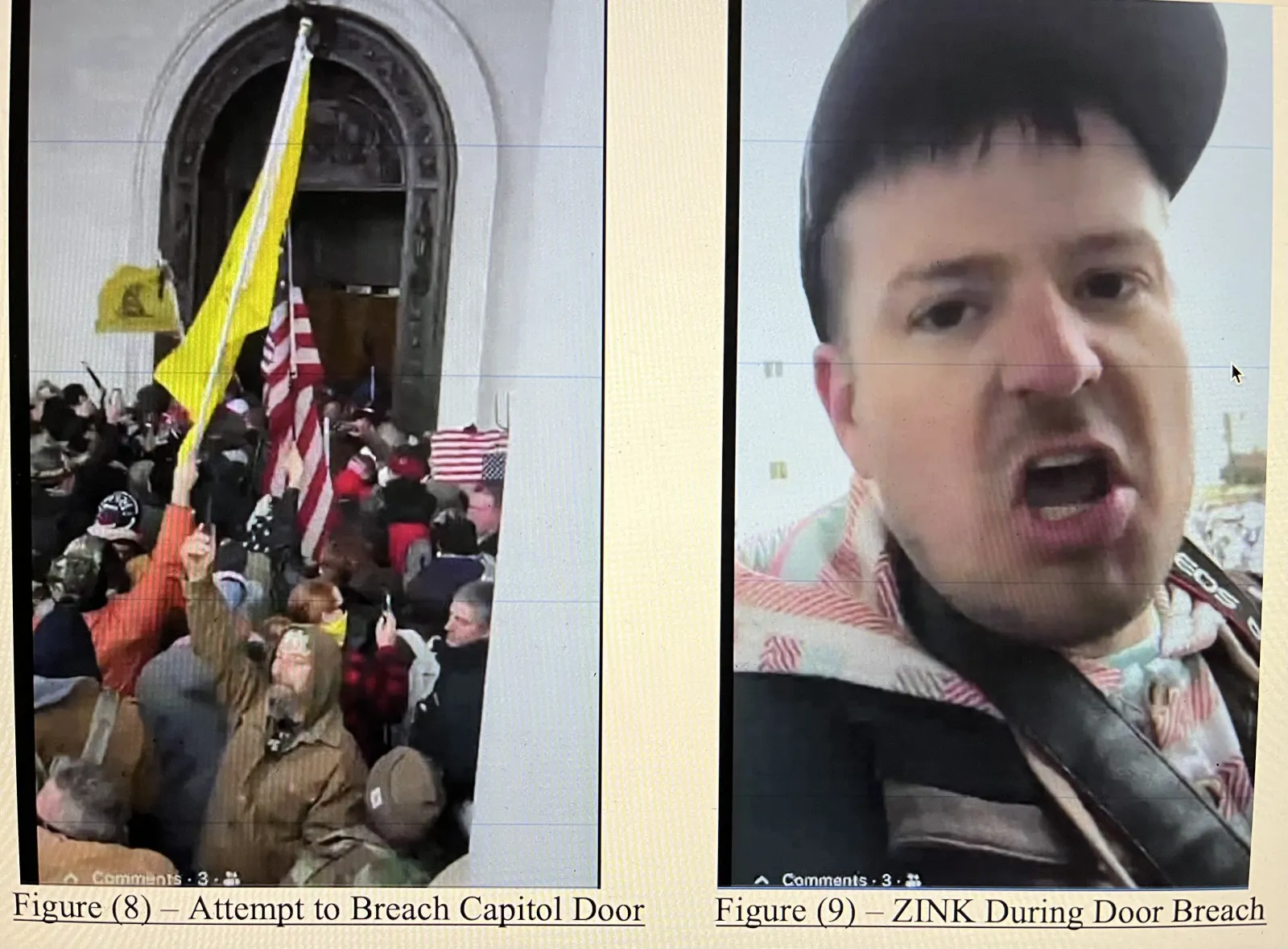
"The Supreme Court's 1512(c)(2) ruling is what we're banking on now," said Jeff Zink, who is J6 defendant Ryan Zink's father and a Republican candidate for U.S. Congress in Arizona. "We're getting the message out by educating people and the press."
While both were at the Capitol on January 6, neither entered the building and only Ryan Zink was charged with crimes, largely due to his menacing posts online.
"We felt the election had been stolen and we wanted to peacefully protest. We didn't participate in any violence," said Jeff Zink.
Attorney Roger Roots, who is defending Ryan Zink and other January 6 defendants, confirmed that some judges have stated they'll consider longer sentences for misdemeanors should 1512 be invalidated, but most have yet to address the prospect.
"The norm in all of federal sentencing is for multi-count sentences to run concurrently. It is highly unusual for courts to sentence people to consecutive sentences for multiple counts," said Roots.
In the case of Zink, he'd likely serve less than a year should 1512 be invalidated, potentially knocking a few decades off his sentence.
"There is probably a lot of case law disfavoring consecutive sentences as an abuse of discretion, unless there are unusual circumstances," said Roots. "The government can ask for more time regarding other counts, but nothing makes judges agree."
...
Roots also represents Stephanie Baez, who entered the Capitol wearing a shirt depicting an image of 1984 author George Orwell and told the FBI she assumed she was allowed in the building because "everyone was calm" and she checked the Capitol's official website to make sure it wasn't closed to the public.
Like Zink, she posted menacing things online that day, including: "Welp time to get back and storm the building" and, "Police let us through the barriers, they only really messed up breaking windows. But it's our capitol building, we pay for it."
Baez was released on $10,000 bail nearly three years ago and faces trial in about a month on misdemeanors, as well as the 1512 charge that prosecutors included later.
"The DOJ vindictively added the charge when she wouldn't plead guilty to misdemeanors," said Roots.
The DOJ told Newsweek it had no comment for this report.
"The 1512 charge was also added vindictively, along with a bogus 'assault' charge, against John Todd when Todd refused to plead to misdemeanors," Roots said of another of his clients.
According to prosecutors, Todd hurled profanities at Metropolitan Police Department officers who instructed him to leave the Capitol Rotunda on January 6 and threatened to "hip toss" one of them. The former Marine also scuffled with an officer, resulting in his makeshift flagpole breaking and the officer needing stitches on a finger.
It's nearly impossible to say specifically how many years will be lopped off sentences should Fischer prevail, since sentences are so far all over the map. James Breheny, for example, was charged under 1512 but received only house arrest, probation and a $2,000 fine because he helped the FBI prosecute others.
Jacob Chansley, the so-called QAnon Shaman who wore a headdress with fur and horns inside the Capitol, might provide one of the cleanest examples, given he was convicted solely of obstruction under 1512 and served 41 months in prison.
Chansley pled guilty to 1512, which has been the norm when it is the only charge, suggesting that plea deals are happening behind the scenes. For those going to trial, 1512 is typically one of many charges, as was the case with Kelly Meggs, convicted of 1512 and a host of other felonies and misdemeanors and sentenced to 12 years.
"The 1512 charge has been the focal point for the DOJ in a lot of the J6 cases. If the court takes the charge away, the landscape of J6 litigation changes significantly," said Roots.
And Brandon Fellows—who became a social-media sensation on Monday as he made silly faces while seated behind Dr. Anthony Fauci during House testimony about his handling of the COVID-19 crisis—was sentenced to 37 months for his 1512 conviction and four misdemeanors, while the judge tacked on an additional five months for contempt given a lack of remorse.
Fellows, who entered the Capitol through a broken window on January 6 and smoked marijuana in a senator's office, already served his prison sentence, though he remains on supervised release for the next 36 months.
After the right praised his behavior at Fauci's hearing and the left criticized it, Fellows addressed Fischer v. United States in a post on X, indicating that it's not too late for him to benefit should Fischer prevail.
"Yes I'm a felon, but only until the Supreme Court dismissed (sic) the felony later this month. Look up the opening statements of USA V Fisher (sic)... My supervised release is about to end," he wrote**.**
View 0 Comments
Submit Correction
View Editorial & AI Guidelines