

By Amanda Castro and Hannah Parry
0
Share
Newsweek is a Trust Project member
See more of our trusted coverage when you search.Prefer Newsweek on Googleto see more of our trusted coverage when you search.
The White House confirmed Thursday that President Donald Trump has been diagnosed with chronic venous insufficiency, a benign vein condition common among older adults. The announcement followed growing public speculation over visible swelling in his legs and bruises on his hands.
What to Know:
- Trump underwent vascular studies and leg ultrasounds after noticing swelling, leading to the diagnosis, said White House Press Secretary Karoline Leavitt in today's press briefing.
- Chronic venous insufficiency affects blood flow in the legs and is common in adults over 70.
- The president showed no signs of deep vein thrombosis, arterial disease, heart failure, or kidney issues.
- A full cardiac evaluation, including an echocardiogram, returned normal results.
- Bruising on Trump's hand was attributed to frequent handshaking and aspirin use for heart health.
- The White House emphasized that Trump remains in excellent health and is not experiencing discomfort.
Newsweek's live blog is closed.
Jul 17, 2025 at 07:56 PM EDT
Read letter from President Trump’s physician on his diagnosis in full
Jul 17, 2025 at 07:45 PM EDT
Who were the oldest presidents to be sworn in?
Donald Trump is the oldest person to be sworn in as President of the United States, having taken the oath of office in January 2025 at the age of 78 years, 7 months, and 6 day.
Joe Biden, in second place, was sworn in at 78 years and 61 days of age.
- Trump - 78 years, 7 months, and 6 day
- Biden - 78 years and 61 days
- Ronald Reagan - 69 years, 349 days
- William Henry Harrison - 68 years, 23 days
- James Buchanan - 65 years, 315 days
- George H. W. Bush - 64 years, 222 days
- Zachary Taylor - 64 years, 100 days
- Dwight D. Eisenhower - 62 years, 98 days
- Andrew Jackson - 61 years, 354 days
- John Adams - 61 years, 125 days
Jul 17, 2025 at 06:58 PM EDT
Trump’s first term physical annual raised concern
Trump's exams during his first administration raised concerns, especially near the end. His final annual physical in 2020 found him to be obese with elevated blood pressure. U.S. Navy Dr. Sean Conley, Trump's physician at the time, however, declared the president "remains healthy" and had "no significant changes to report" from his previous annual physical.
The president is not required to release the results of his annual physical exam, according to the Associated Press. President Richard Nixon was the first modern president to publicize his medical exam, which has since then become customary practice.
Jul 17, 2025 at 06:44 PM EDT
Last major health update from Donald Trump’s doctor
President Donald Trump's doctor released their last official memo regarding the commander-in-chief's health in April, after he underwent an annual physical on Friday.
Trump underwent his annual physical on Friday, April 11, at Walter Reed National Military Medical Center under the care of Captain Sean Barbabella, who serves as the president's physician.
Barbabella shared the following details from the physical, according to the memo emailed to Newsweek by the White House:
"President Trump remains in excellent health, exhibiting robust cardiac, pulmonary, neurological, and general physical function. His active lifestyle continues to contribute significantly to his well-being."
"President Trump's days include participation in multiple meetings, public appearances, press availability, and frequent victories in golf events. President Trump exhibits excellent cognitive and physical health and is fully fit to execute the duties of the Commander-in-Chief and Head of State," the memo read.
Trump's "vital statistics" list his height as 75 inches (or 6 feet and 3 inches tall), his weight as 224 pounds, with a resting heart rate of 62 beats per minute and a blood pressure of 128/74. In 2020, he had weighed 244 pounds and had a blood pressure of 121/79.
Jul 17, 2025 at 05:56 PM EDT
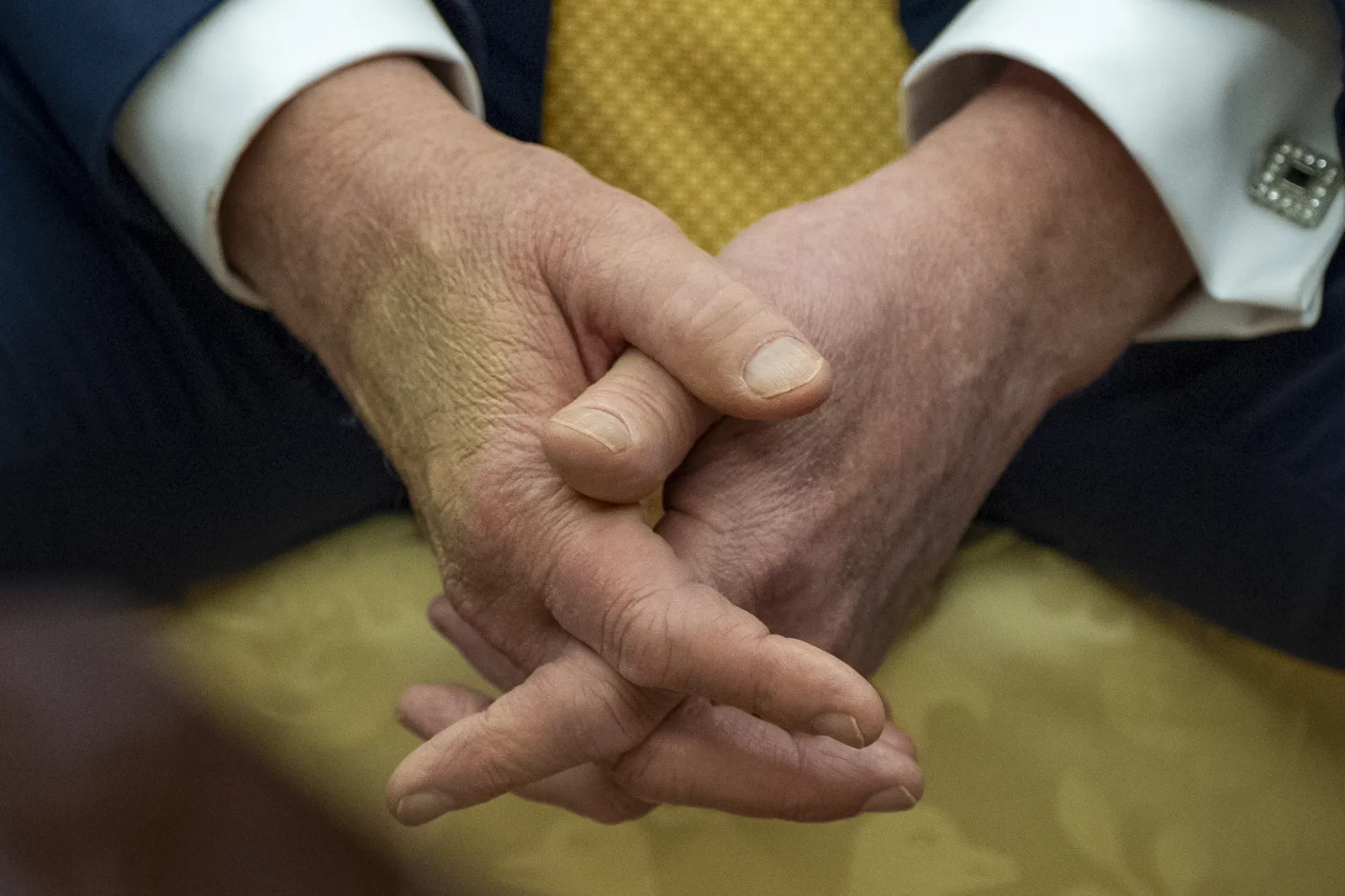
IN PICTURES: Trump’s hand appears to show makeup covering a bruise or blemish
President Donald Trump's right hand appeared to have makeup covering up a bruise or blemish on it Wednesday.
Photos from Trump shaking hands with Bahrain's Crown Prince Salman bin Hamad Al Khalifa at White House, Wednesday, show what looks to be coverup or foundation on the back of his right hand.
Today, the White House has confirmed that Trump has suffered bruises on his hand, blaming irritation from handshakes combined with taking aspirin, a blood thinner.

...
...
Jul 17, 2025 at 05:31 PM EDT
IN PICTURES: President Trump’s swollen ankle
President Donald Trump has been spotted with what appears to be heavily swollen ankles at a number of public events in recent months.
A photo taken during Trump's White House meeting with with Bahrain's Crown Prince Salman bin Hamad Al Khalifa on Wednesday, shows the president's left ankle which appears to be swollen and bulging out of his shoe.
On Thursday, the White House said the swollen ankles are due to chronic venous insufficiency.

...
Jul 17, 2025 at 05:09 PM EDT
Does taking aspirin mean you bruise more easily?
On Thursday, White House press secretary Karoline Leavitt claimed that President Donald Trump's hand bruises were "consistent" with irritation from "frequent handshaking and the use of aspirin."
Aspirin affects bruising by interfering with blood clotting. It works as an antiplatelet drug, preventing platelets from sticking together and forming clots by blocking an enzyme called COX. This makes it useful for preventing heart attacks and strokes but also increases the risk of bleeding.
Because clotting is slowed, blood may leak longer from damaged vessels, leading to larger or more noticeable bruises. Even minor bumps can cause bruising, and healing may take longer than usual. This effect can occur even with low-dose aspirin and is more pronounced with long-term use.
If you notice large, unexplained, or frequent bruises—especially along with other signs of bleeding like nosebleeds or bloody urine—it's important to consult a doctor. Never stop taking aspirin without medical advice, especially if it was prescribed for heart or stroke prevention.
Jul 17, 2025 at 04:51 PM EDT
Varicose veins vs chronic venous insufficiency: Differences explained
Varicose veins and chronic venous insufficiency are related but distinct conditions.
Varicose veins are enlarged, twisted veins that are often visible just under the skin's surface and are a common symptom of CVI.
While varicose veins may exist on their own as a cosmetic concern, chronic venous insufficiency is a broader and more serious condition that involves impaired blood flow and valve dysfunction in the leg veins.
CVI can lead to significant discomfort and complications like skin changes and ulcers, whereas varicose veins may not always cause symptoms. However, untreated varicose veins can progress into CVI over time.
Jul 17, 2025 at 04:30 PM EDT
What are symptoms of chronic venous insufficiency and how is it treated?
Symptoms of CVI include leg swelling, aching or cramping, heaviness, visible varicose veins, skin discoloration, and in more advanced cases, ulcers around the ankles. These symptoms often worsen after long periods of standing or sitting and improve with leg elevation.
Treatment for CVI depends on severity but often starts with lifestyle changes like regular exercise, leg elevation, and wearing compression stockings. In more persistent or severe cases, medical interventions such as sclerotherapy, laser therapy, or vein surgery may be recommended to improve blood flow and relieve symptoms.
The National Library of Health's MedlinePlus website says, "Venous insufficiency is a condition in which the veins have problems sending blood from the legs back to the heart."
The condition "tends to get worse over time" but "can be managed if treatment is started in the early stated stages," the website says.
Jul 17, 2025 at 04:15 PM EDT
White House addresses speculation about Trump’s physical appearance
White House Press Secretary Karoline Leavitt on Thursday read a letter from a physician aimed at addressing public concerns over visible swelling in former President Trump's ankles and bruising on his hand, which had been concealed with makeup.
Leavitt explained that Trump had noticed "mild swelling" in his lower legs and was evaluated by the White House medical unit, which found "no evidence of deep vein thrombosis or arterial disease."
Instead, doctors determined he has chronic venous insufficiency (CVI), or blood pooling in his veins, a condition Leavitt described as common among individuals over the age of 70.
She added that Trump was not experiencing any discomfort related to the condition.
Read in full from Gabe Whisnant on Newsweek.
Jul 17, 2025 at 03:57 PM EDT
More on Trump’s medical history
Trump's health has long been a subject of public scrutiny, especially as he became the oldest president to begin a second term at age 78. While Trump has released intermittent updates over the years, calls for full transparency have intensified, particularly following Vice President Kamala Harris's detailed medical disclosure in October 2024.
According to Axios, Trump's campaign has shared limited information, including a November 2023 letter from his physician, which describes him as being in "excellent health." The letter cited favorable lab results, weight loss, and "exceptional" cognitive performance, though it lacked specific metrics. Trump also scored 30 out of 30 on a Montreal Cognitive Assessment in 2018, but no recent cognitive evaluations have been released.
His medical history includes high cholesterol, coronary artery disease, and a past COVID-19 hospitalization in 2020. He reportedly takes medications for cholesterol, cardiac prevention, and rosacea, and underwent cataract surgery and a colonoscopy in 2024 that revealed a benign polyp and diverticulitis.
Trump's family history includes Alzheimer's disease; his father was diagnosed in 1991, which some experts say may increase his risk for cognitive decline.
Jul 17, 2025 at 03:45 PM EDT
Trump has no evidence of deep vein thrombosis
Trump has been diagnosed with chronic venous insufficiency (CVI), a condition that affects roughly 1 in 20 adults and becomes more common with age, according to the Cleveland Clinic.
CVI occurs when leg veins fail to efficiently return blood to the heart, causing it to pool in the lower extremities. Johns Hopkins Medicine notes that while CVI is not life-threatening, it can be painful and disabling if left untreated.
Trump underwent a medical evaluation after noticing swelling in his legs and bruising on his hands. His physician confirmed there was no evidence of deep vein thrombosis (DVT), a more serious condition involving blood clots in deep veins, often in the legs. The bruising was attributed to minor soft tissue irritation from frequent handshaking and the use of aspirin.
Risk factors for CVI include age, obesity, pregnancy, smoking, and a sedentary lifestyle. Treatment typically involves compression therapy, regular exercise, and elevating the legs to improve circulation.
Despite the diagnosis, Trump's physician reported that the president remains in excellent health.
Jul 17, 2025 at 03:30 PM EDT
What to know about chronic venous insufficiency
Chronic venous insufficiency (CVI) is a condition in which leg veins fail to efficiently return blood to the heart, often due to weakened or damaged valves. This leads to blood pooling in the lower extremities, causing discomfort and potential complications if left untreated. While CVI is not considered life-threatening, it can significantly impact quality of life.
According to Johns Hopkins Medicine, symptoms of CVI include swelling, leg cramps, varicose veins, skin discoloration, and ulcers. Risk factors range from age and obesity to prolonged standing, smoking, and a history of blood clots or leg injuries. Diagnosis typically involves a Duplex ultrasound to assess vein structure and blood flow.
Treatment options vary based on severity and may include compression therapy, exercise, medications like aspirin, and minimally invasive procedures such as endovenous laser ablation or sclerotherapy. In advanced cases, surgical interventions like vein ligation or stripping may be necessary.
Johns Hopkins added that while CVI is common—especially in adults over 50—it can be managed effectively with proper care and lifestyle adjustments.
Jul 17, 2025 at 03:18 PM EDT
Trump diagnosed with chronic vein condition, White House says

...
President Donald Trump has been diagnosed with chronic venous insufficiency, a common and benign vein condition that affects blood flow in the legs, the White House confirmed Thursday. The diagnosis followed medical tests prompted by swelling in Trump's lower legs, which revealed no signs of deep vein thrombosis, arterial disease, or systemic illness.
White House press secretary Karoline Leavitt said Trump, 79, remains in excellent health and is experiencing no discomfort. An echocardiogram and full lab work returned normal results. Leavitt also addressed speculation over bruising on Trump's hand, attributing it to minor soft tissue irritation from frequent handshaking and aspirin use as part of his cardiac care regimen.
View 0 Comments
Submit Correction
View Editorial & AI Guidelines