...

By Melissa Fleur Afshar
Reporter
0
Share
Newsweek is a Trust Project member
See more of our trusted coverage when you search.Prefer Newsweek on Googleto see more of our trusted coverage when you search.
Billions of people around the world are celebrating the Lunar New Year.
But unlike the Solar New Year, the festival is not anchored to a fixed date on the solar calendar, but to the moon’s rhythm—beginning with the first new moon of the lunar calendar and unfolding as families turn toward renewed energy and luck.
In 2026, Lunar New Year, often called Chinese New Year or the Spring Festival, begins on February 17, launching 15 days of celebrations that culminate with the Lantern Festival on the first full moon of the new lunar year.
Read More on Life
This year also ushers in the Year of the Fire Horse, one of the Chinese zodiac’s most-distinctive animals, shaping the themes and symbolism many people look to as the holiday season begins.
What Is the Lunar New Year?
Most of the world organizes time through a solar year—the cycle created by Earth’s orbit around the sun. But, long before modern calendars standardized dates, societies measured passing months by the moon, tracking its phases to mark time: a lunar year.
Lunar New Year is, at its core, the first day of that lunar calendar cycle.
China still observes the solar year too, with January 1 remaining its modern public marker of "New Year"—but Chinese New Year celebrates the Lunar New Year.
Because the solar and lunar systems are not perfectly aligned, the holiday does not "sync" neatly with the Gregorian calendar. Instead, it shifts each year, typically landing in late January or February depending on the moon.
While it is commonly referred to as "Chinese New Year," the holiday is celebrated well beyond China, including across Asia and in diaspora communities worldwide—one reason it is often described more broadly as Lunar New Year. It is also widely considered among the most-important holidays in Chinese culture.
The celebration runs for 15 days, moving from New Year’s Eve gatherings through to the Lantern Festival, when illuminated lanterns mark the closing night. Over that arc, the holiday’s through-line is unmistakable: renewal—a symbolic clearing out of old misfortune and an invitation to better luck and fresh fortune.
Many traditions are built around that idea. Homes are cleaned before the new year arrives, a practical ritual that doubles as a symbolic sweep of lingering bad luck. Yet, once the new year begins, sweeping and cleaning are often avoided for several days—an effort, in traditional belief, not to disturb the good luck newly welcomed in.
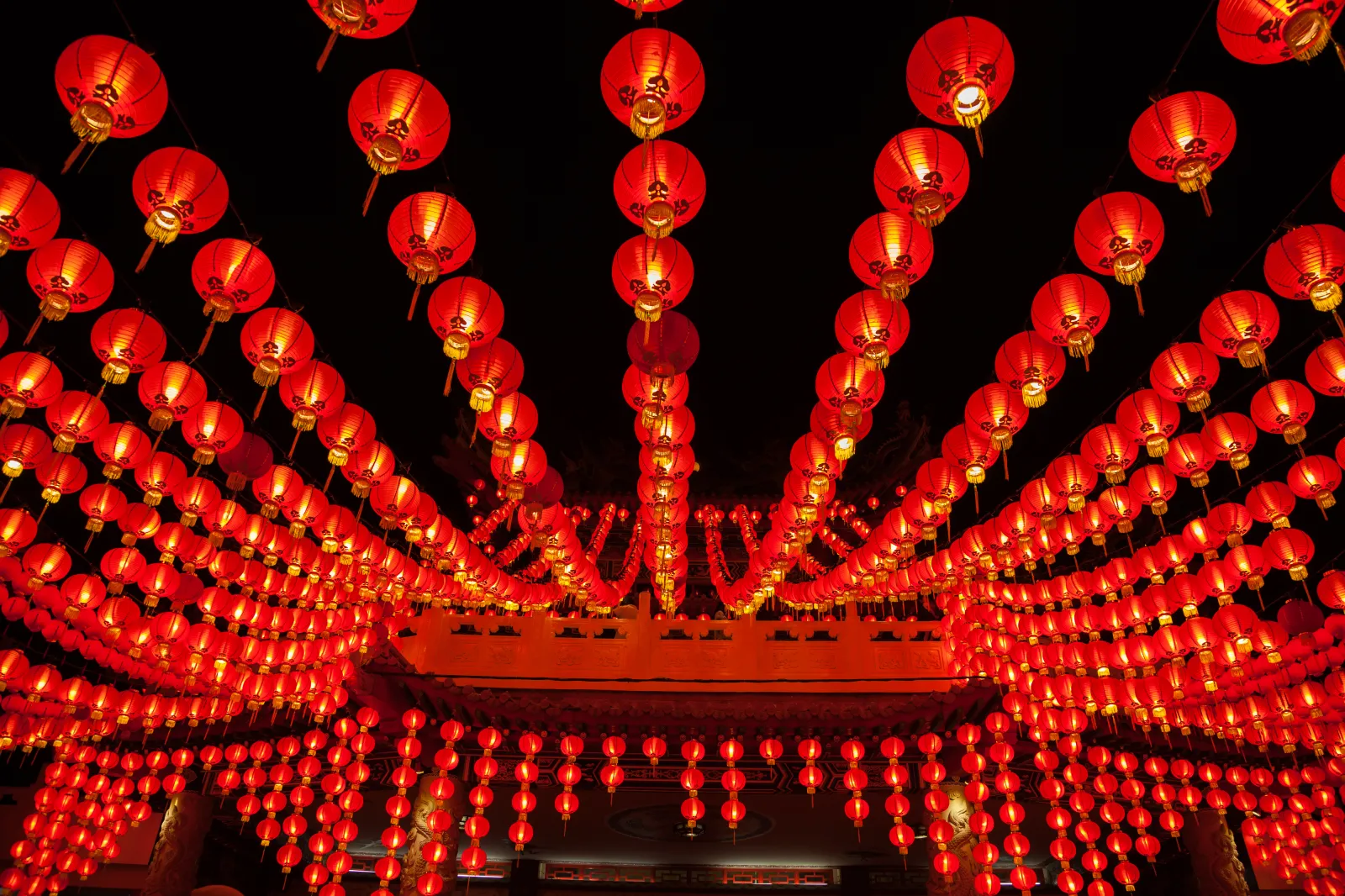
The holiday’s vivid esthetics—especially the dominance of red—also speak to protection and optimism.
Red is widely associated with luck, joy, prosperity and protection in Chinese culture, and it is everywhere during the Lunar New Year, through banners, clothing, door decorations and envelopes.
Fireworks and firecrackers, too, are not just spectacle. They are tied to one of the best-known Lunar New Year legends: the story of Nian, a monster said to appear at the new year, frightened away by loud noises and the color red—a folklore explanation for why the holiday is, famously, both bright and thunderous.
...
At the heart of the season is family. Lunar New Year’s Eve is marked by a large family dinner—an emblem of togetherness and continuity—followed by days of visiting and well-wishing. And, for children, one of the most-anticipated customs is the giving of red envelopes containing money, typically offered by elders as "lucky money," wrapped in the holiday’s signature color.
While the amount gifted may vary, many families will opt to send figures with the letter 8 in them, due to the number's status as "lucky" within Chinese culture.
Finally, the Lantern Festival—closing the 15-day cycle—leans into the holiday’s emotional core.
Lanterns are often described as symbols of hope, light and guidance.
What Does the Year of the Fire Horse Symbolize and What to Expect
Every Lunar New Year also turns the page in the Chinese zodiac, a 12-animal cycle.
In that tradition, your zodiac sign is determined by your birth year, and each animal is often linked to a set of character traits that people use as cultural shorthand—whether playfully, spiritually, or as a way of narrating the year ahead.
In 2026, the zodiac shifts to the Horse, specifically the Fire Horse, beginning on February 17. The "Fire" designation comes from the way zodiac years are paired with one of five elements, creating combinations that repeat across a longer cycle.
Culturally, Horse years are often framed as energetic—more motion than pause, more momentum than contemplation. And the Fire Horse, in particular, is widely described as turning up the dial: energetic, determined, action-oriented.
In other words, if the zodiac is a symbolic story people tell about time, the Fire Horse chapter is written in a faster tempo.
That same symbolism shapes how many interpret the "feel" of the year.
Fire Horse people are commonly characterized as spirited and driven—and believers say the year itself can carry those qualities, too: a sense that things will happen, decisions will be made quickly, and plans may move from idea to action with less hesitation.
View 0 Comments
Submit Correction
View Editorial & AI Guidelines