...

By Steve Mollman
News Editor
0
Share
Newsweek is a Trust Project member
See more of our trusted coverage when you search.Prefer Newsweek on Googleto see more of our trusted coverage when you search.
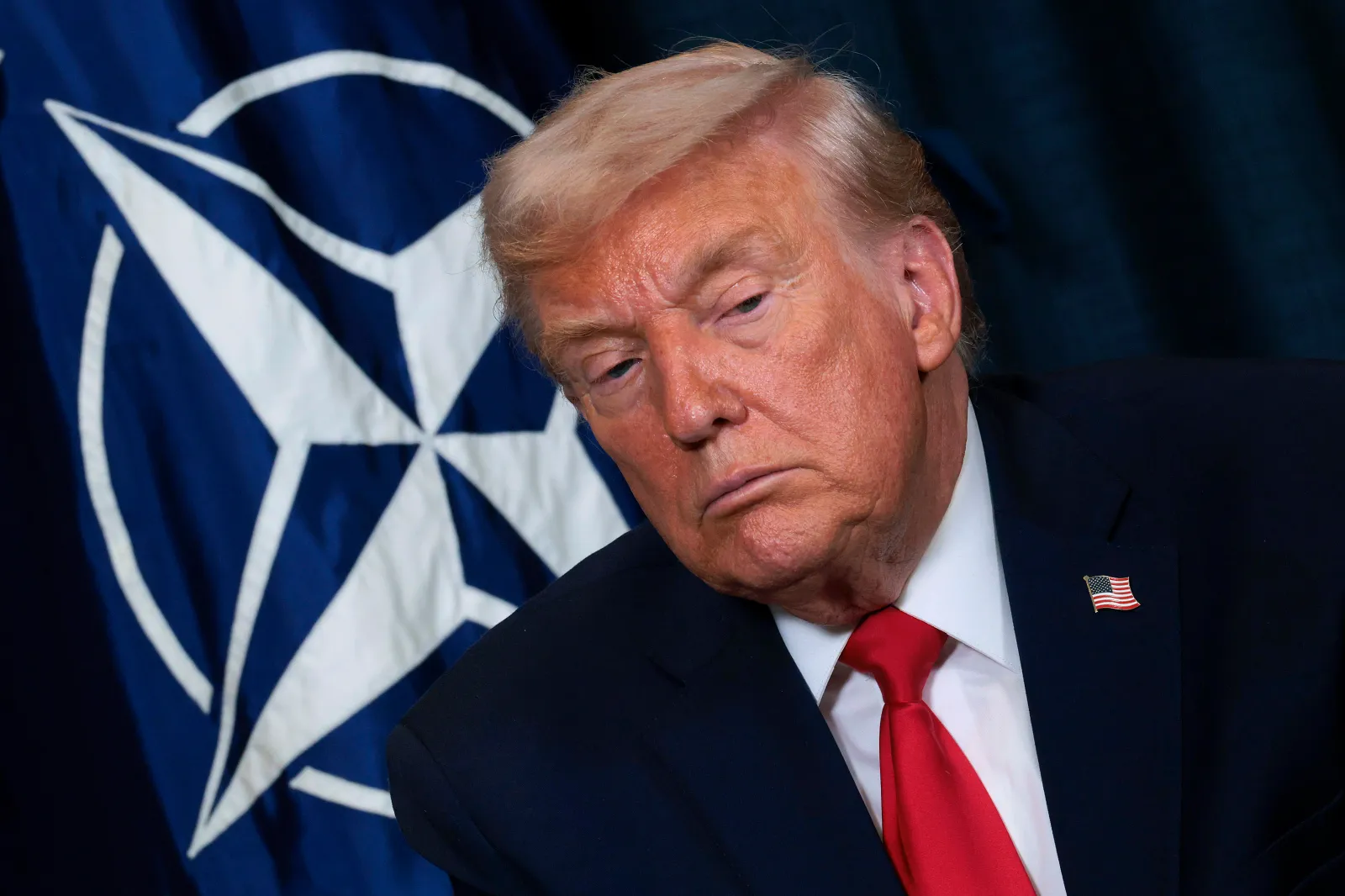
The North Atlantic Treaty Organization (NATO) marked its 77th anniversary on Saturday as renewed questions emerged over the United States’ commitment to the alliance, following a fresh round of criticism from President Donald Trump that has unsettled allies at a time of widening global conflict.
NATO was founded in 1949 in the aftermath of World War II to provide collective defense for its members, binding the U.S. to the security of Europe through a system designed to deter aggression and prevent another continental war. At the heart of the alliance is Article 5, the mutual defense clause stating that an attack on one member is considered an attack on all.
Trump Pressures Allies Over Iran War and Strait of Hormuz
NATO’s latest anniversary arrives amid unusually open doubts from its most powerful member. Trump has in recent weeks criticized NATO allies for refusing to assist U.S.-led efforts to reopen the Strait of Hormuz, a critical global shipping route disrupted during the ongoing U.S.-Israeli war with Iran.
Read More on News
Last month, Trump lashed out at NATO allies on Truth Social, accusing them of benefiting from U.S. military power while refusing to help secure shipping routes affected by the war. “Without the U.S.A., NATO IS A PAPER TIGER!” he wrote, concluding his post by calling allies “COWARDS” and warning, “we will REMEMBER!”
After Spain, a member of the alliance, earlier this week closed its airspace to U.S. aircraft involved in the war, U.S. Secretary of State Marco Rubio noted the alliance remains valuable to Washington because it allows it to station troops and aircraft in parts of the world where the U.S. would not otherwise have bases.
“But if NATO is just about us defending Europe if they’re attacked but then denying us basing rights when we need them, that’s not a very good arrangement,” Rubio told Al Jazeera on Monday. “That’s a hard one to stay engaged in and say this is good for the United States. So all of that is going to have to be reexamined.”
Allies Say Iran War Is Not a NATO Mission
Several NATO countries have declined to send naval forces to the region, arguing the conflict is not a NATO mission and warning further involvement risks escalation.
"This is not our war, we have not started it," Germany's Defense Minister Boris Pistorius said last month.
Trump has responded by accusing allies of failing to meet their obligations and by questioning whether the U.S. should continue to shoulder the alliance’s security burden.
If alliance countries rejected his demands on helping to reopen the Hormuz Strait, he warned last month, "it will be very bad for the future of NATO."
The remarks echo a long-standing pattern. Trump has repeatedly attacked NATO over defense spending, burden-sharing, and what he describes as unfair treatment of U.S. taxpayers, raising similar concerns during his first term and again during his return to office.
While Trump has not announced a formal move to withdraw from NATO, his rhetoric has alarmed European leaders who warn that uncertainty alone can weaken deterrence. Article 5 has been invoked only once, after the September 11, 2001, attacks on the U.S., but its power lies in credibility rather than frequency.
French President Emmanuel Macron has been among the most outspoken critics of Trump’s rhetoric, warning that repeated public doubts about U.S. commitment risk hollowing out the alliance.
“If you create doubt every day about your commitment, you hollow it out,” Macron said this week.
Trump’s approach to NATO has also been shaped by his repeated comments about Greenland, a semi‑autonomous territory of NATO ally Denmark. Since returning to office, Trump has argued the U.S. must take control of the island for national security reasons, at times refusing to rule out the use of force or economic pressure. Those remarks triggered sharp backlash from European allies, mass protests in Denmark and Greenland, and warnings from NATO leaders that threats against a member state undermine the alliance’s core principle of collective defense. While Trump later said he had reached a “framework” for talks with NATO leaders on Arctic security, the episode deepened concerns in European capitals that U.S. security guarantees could be treated as conditional.
European officials have stressed that adversaries closely watch signals of unity or division within NATO and may be emboldened by signs that the alliance’s guarantees are conditional.
Those concerns have been sharpened by the Iran war, which has already begun to brush up against NATO’s borders. Alliance air and missile defense systems have intercepted projectiles near or inside NATO airspace in recent weeks, particularly involving Turkey, highlighting how quickly a regional conflict could spill into alliance territory.
...
NATO Expands and Defense Spending Rises Across Europe
NATO today is militarily stronger than at any point since the Cold War. The alliance has expanded to 32 members following the accession of Finland and Sweden, a historic shift prompted by Russia’s invasion of Ukraine and growing fears about Moscow’s long-term intentions.
Defense spending across Europe has surged, with all members now meeting or approaching the long-standing goal of spending at least 2 percent of GDP on defense, and several countries committing to significantly higher levels in the coming years. Trump has claimed credit for those increases, saying that sustained pressure from Washington forced allies to act.
“I MADE NATO STRONG… When I told the 20 Countries that weren’t paying their fair share that they had to PAY UP, and said without doing that you will not have U.S. Military Protection, the money came rolling in,” Trump wrote on Truth Social in early 2024.
Yet the Iran war has exposed disagreements about NATO’s purpose. Many allies view the alliance as a defensive pact focused on the Euro-Atlantic region, not as a mechanism for supporting U.S. military operations in the Middle East. That divide has widened as the Trump administration has pressed allies for help while simultaneously questioning the value of the alliance itself.
Congress and Republicans Push Back on NATO Skepticism
Legally, a U.S. withdrawal from NATO would face significant obstacles. Congress has passed legislation restricting a president’s ability to exit the alliance without approval from lawmakers, reflecting bipartisan concern over the strategic consequences of withdrawal.
And it wouldn’t be just Democrats defending NATO. Republican lawmakers have done so as well, even in the face of Trump’s attacks. Senator Thom Tillis of North Carolina responded to Trump calling NATO allies “cowards” over reopening the Strait of Hormuz, telling ABC News' This Week, “I don't think that they're cowards. I think they're people that weren't consulted on a major military operation, and I'd have the same reaction if I was the head of state.”
On Saturday, GOP Representative Don Bacon of Nebraska—a frequent critic of Trump regarding NATO—made clear his support of the alliance, writing on X: “Today marks 77 great years of @NATO, the most successful alliance in history. The U.S. is stronger when NATO is strong and cohesive, something I saw firsthand while serving in NATO. We need our allies to counter threats from China, Russia, and Iran. We cannot do it alone.”
Security analysts have repeatedly cautioned that deterrence depends on belief as much as capability. If adversaries conclude that NATO members doubt whether the U.S. would respond to an attack, the alliance’s central promise could be weakened without a single treaty being torn up.
As NATO enters its 78th year, leaders face the challenge of projecting unity at a moment when global threats are multiplying and political divisions are deepening. The alliance has survived past crises and internal disputes, but whether it can withstand sustained uncertainty from its most powerful member may prove to be the defining test of its next decade.
In a polarized era, the center is dismissed as bland. At Newsweek, ours is different: The Courageous Center—it's not "both sides," it's sharp, challenging and alive with ideas. We follow facts, not factions. If that sounds like the kind of journalism you want to see thrive, we need you.
When you become a Newsweek Member, you support a mission to keep the center strong and vibrant. Members enjoy: Ad-free browsing, exclusive content and editor conversations. Help keep the center courageous. Join today.


View 0 Comments
Submit Correction
View Editorial & AI Guidelines