...


By Monica Sager and Jesus Mesa
0
Share
Newsweek is a Trust Project member
See more of our trusted coverage when you search.Prefer Newsweek on Googleto see more of our trusted coverage when you search.
There are 538 votes that make up the electoral college, a number based on each state's delegates in the Senate and House of Representatives. To win the White House, a candidate needs 270 of them.
Since 38 of the 50 U.S. states have voted for the same political party from 2000 to 2016, the winner is almost always determined by a handful of "swing states," which as the name implies often "swing" between the two major political parties.
Also known as "battleground states" or "purple" states, these are the most competitive areas in the presidential election. They are where the candidates spend most of their time on the campaign trail, and where a flood of money from outside political groups is targeted, mostly in the form of advertisements.
Read More on Politics
...
While the states themselves change with the times, the concept of a swing state is as old as the democracy itself. Harry Truman beat Thomas Dewey in 1948 by winning less than 1% of the popular vote in then-swing states Ohio, California, Indiana, Illinois and New York. The 1960 election between Richard Nixon and John F. Kennedy came down to less than 2% of the vote across 10 states. The 2000 presidential election, infamously, came down to Florida.
Until recently, Ohio was considered a must-win state for both parties before it started trending toward the GOP column. When Joe Biden won in 2020, he became just the third president to win an election without carrying the Buckeye State. A similar scenario has played out in Florida, which is now more or less a "red" state — though the Democrats have new hope that it could be in play this November.
The Seven Battlegrounds
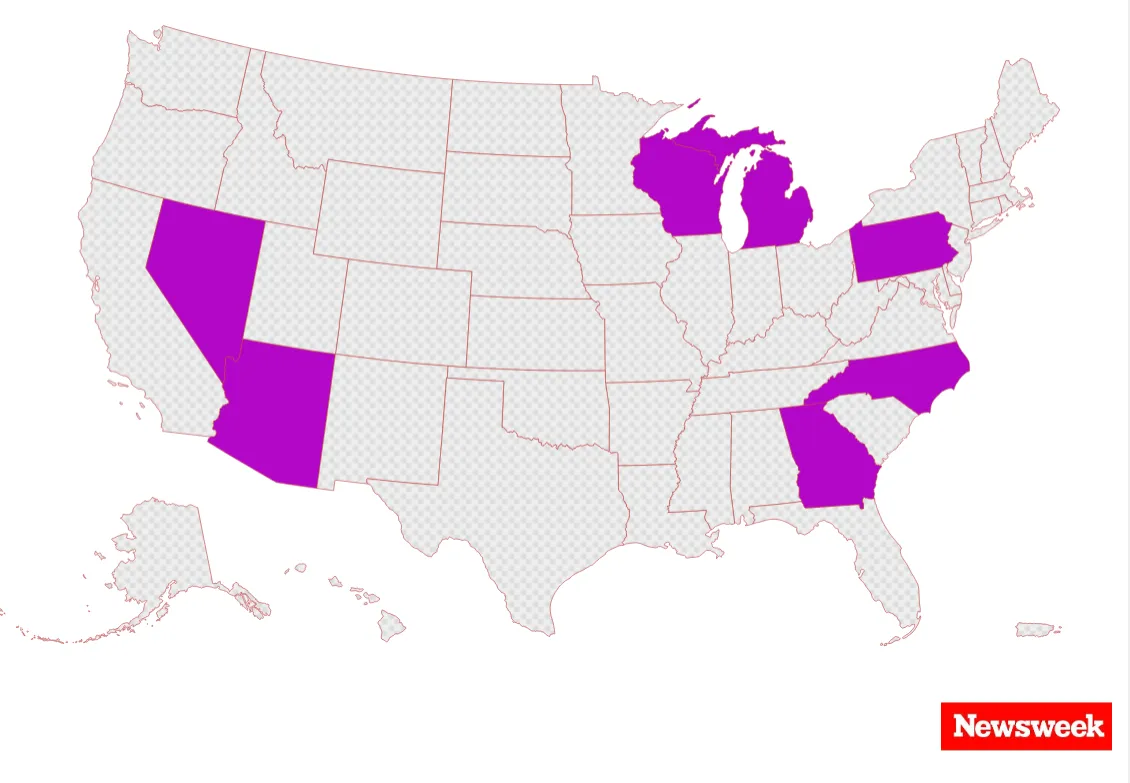
This cycle, the winner will need to carry some or all of the following seven states: Nevada, Arizona, Georgia, North Carolina, Pennsylvania, Michigan and Wisconsin.
To that end, Vice President Kamala Harris and her running mate, Gov. Tim Walz, announced a bus tour across Pennsylvania ahead of the Democratic National Convention in Chicago next week. Harris or Walz have traveled in the past two weeks to all seven of this year's battlegrounds.
The Democratic National Committee also launched its first major paid advertising campaign this week, blanketing the airwaves in those states.
Former President Donald Trump has also visited many of the battleground states this cycle, including Pennsylvania, where he was nearly killed in an assassination attempt last month. His running mate, Sen. JD Vance — himself from the former swing state of Ohio — has been on the trail in the battlegrounds, as well.
Arizona
Trump and Harris are locked in a fierce battle for Arizona's 11 electoral votes. While polls show Trump slightly ahead, with one recent poll giving him a 5-point lead over Harris, the overall polling average suggests Harris is gaining ground, making a Trump victory far from guaranteed.
A longtime Republican stronghold, Arizona played a crucial role in Biden's 2020 victory, narrowly backing a Democratic candidate for the first time since the 1990s. Biden won the state by 0.3%, with 49.4% of the vote—the highest level of support for a Democratic candidate in Arizona since 1964. This shift has led many experts to now classify the state as "purple," reflecting its evolving political landscape from what was once a consistent win for the GOP.
Arizona's changing political identity is closely tied to its geographical and demographic makeup. With its proximity to the U.S.-Mexico border, immigration has long been a central issue for voters. Trump has further cemented his appeal by pledging to initiate "the largest deportation operation" in U.S. history if re-elected—a promise aimed directly at voters who prioritize immigration policy.
Despite this, recent years have seen a notable shift in the state's stance on immigration. Arizona voters have increasingly shown a more moderate approach, supporting measures like in-state tuition rates for undocumented students and rejecting other hard-line policies.
Arizona has also become a battleground over abortion access, underlined earlier this year when state Republicans tried and failed to reinstate a 160-year-old near-total ban on terminating pregnancies.
The abortion issue has been a winning one for Democrats in the Grand Canyon State, since the Supreme Court's Dobbs decision that overturned Roe v. Wade. Democrats are hoping to leverage this issue to galvanize support up and down the ticket, particularly among women and younger residents. In the 2022 midterms, Democrats won Arizona's gubernatorial seat, secretary of state, attorney general and the state's open seat in the U.S. Senate.
However, a recent Pew Research Survey showed that the state is still divided on the issue, with 49% of Arizonans supporting abortion in all cases and 46% opposing it.

...
Today, the state's political dynamics remain fluid. Although Republicans currently outnumber Democrats in terms of party registration, 35% to 29%, a third of voters are classified as independents or unaffiliated, with the rest identifying as Libertarian or Green Party members.
Last month, Harris and Walz held a rally in Glendale, drawing a crowd of around 20,000 people. The rally, part of their tour of battleground states, focused on issues like climate change and reproductive rights. In contrast, Trump's last visit to Arizona was in early June, when he held a town hall-style event in Phoenix, marking his return to the state since late 2022.
Georgia
Georgia has solidified its status as a critical swing state, particularly following the 2020 election when it narrowly flipped from Trump to Biden. After voting Republican in six consecutive presidential elections, Georgia went to the Democrats for the first time since Bill Clinton won in 1992.
The state's political landscape is heavily influenced by its significant Black population, which makes up a third of its voter base — one of the highest proportions in the nation. This demographic was crucial to Biden's victory, and Kamala Harris's campaign is counting on strong turnout among Black voters to secure Georgia once again in 2024.

...
Adding to the complexity of Georgia's political environment are Donald Trump's ongoing legal battles. Trump and 18 others have been indicted for alleged election interference in Georgia, accused of attempting to overturn the 2020 results there. While Trump denies any wrongdoing, the case adds a layer of uncertainty to the 2024 race.
Reflecting Georgia's volatile political dynamics, the Cook Political Report recently reclassified the state from "lean Republican" to "toss-up." Both parties recognize Georgia's pivotal role are investing heavily in the state. For the Harris campaign, energizing Black voters and countering any potential erosion of support will be crucial. Meanwhile, the Trump campaign is focusing on "kitchen table issues" like the economy, inflation and immigration, aiming to win over moderate voters dissatisfied with the current administration's performance.
Polling data also highlights the shifting dynamics in Georgia. Before Biden dropped out of the race, disillusionment among Black voters had given Trump a lead in some polls. However, the Harris campaign quickly reversed this trend, bringing support back to the Democratic ticket.
This is why Georgia is a key focus for Harris' campaign. Last week, Harris and Walz took a two-day bus tour through southeast Georgia. Campaign officials believe that to defeat Trump, they'll need more support than just Atlanta and its suburbs, which helped Biden in 2020. Expect to see the Harris camp do much voter reach out in rural and exurban areas of the state.
Meanwhile, although Trump hasn't visited Georgia recently, last month he made a significant step in mending his political relationship with the state's popular governor, Brian Kemp, after years of tension. Kemp, who had previously clashed with Trump over his refusal to support claims of election fraud in 2020, publicly endorsed Trump during an interview on Fox News. Trump will need Kemp's vast and well-oiled political machine to help carry the state.
Michigan
Michigan, a perennial battleground state, has played a decisive role in recent presidential elections. As part of the "blue belt" from 1992 through 2012, the state's political landscape has remained highly contested. Trump narrowly flipped Michigan in 2016, defeating Hillary Clinton by just 0.2%—the closest margin of any state that year. In 2020, Joe Biden won Michigan by 2.8%, returning it to the Democratic column.

...
In the 2024 race, Michigan's significant Arab-American population has become a focal point, given Biden's ongoing support for Israel during the Gaza war. This stance has led to backlash among some voters, with over 100,000 opting for the "uncommitted" option during the Democratic primary, reflecting widespread discontent with the administration's foreign policy.
Trump's campaign has tried to seize on the opportunity to bolster his appeal in Michigan, calling for a swift resolution to the conflict in the Middle East. The Harris campaign, meanwhile, has adopted a somewhat more measured tone on the issue, hoping to regain the support of Arab-American voters who feel alienated from the party.
Polls have shown relatively big shifts in Michigan following some of the huge political developments this summer. After the debate and assassination attempt on Trump, the state polling average widened to give the Republican a three-point lead before Biden announced he would leave the race.
As Harris has consolidated support among Democrats, recent polls show her closing that gap. While it remains a close race, the vice president has been doing better in Michigan for the past month.
In an effort to win Michigan, Trump made several visits to the state in August, with his most recent stop just before Labor Day. Speaking in Detroit and Potterville, he announced a proposal to make IVF treatments free for women if he wins a second term. However, he did not provide details on how he would fund the plan or how it would be implemented.
Harris held a rally in Detroit on August 7, attracting 15,000 people and introducing Walz from neighboring Minnesota. On Labor Day, she returned to the battleground, delivering a speech alongside union leaders after formally accepting the Democratic nomination.
Her campaign has been silent on whether she still supports an EV mandate from 2035, a position she took during her failed 2020 campaign that would likely rankle Michigan's auto industry should she continue to endorse it.
Nevada
Nevada's status as a battleground has been thrust into the spotlight by the debate over a new economic issue: the proposal to eliminate taxes on tips. Both Trump and Harris, while visiting the state, announced plans to remove federal taxes on tips, aiming to win over Nevada's large service-industry workforce.

...
In a state where hospitality jobs are a driving force of the economy, this proposal holds significant appeal to voters, particularly as Nevada's post-COVID economic recovery has been slower than in other parts of the country. With an unemployment rate of 5.1%, the highest in the nation, the economy remains a central concern for Nevada voters.
With its six electoral votes, Nevada is somewhat less of a prize than neighboring Arizona. The state's large Hispanic population, comprising nearly 20% of voters, is expected to play a decisive role in the outcome.
Nevada has voted blue in recent presidential elections, but polls suggest it's a toss-up for 2024. Before Biden's withdrawal, Trump had a strong lead. With Harris now in the race, the dynamics have shifted, and she holds a slight lead over Trump in Nevada, though it is often within or just outside the margin of error.
Trump last visited Nevada on August 23rd for a rally in Las Vegas, where he accepted Robert F. Kennedy endorsement and delivered details of his 'No Tax for Tips' policy. Harris recently held a rally in Vegas on August 10.
North Carolina
According to the latest analysis by the Cook Political Report, Harris has erased Trump's eight-point lead in North Carolina, shifting the state's rating from "lean Republican" to "toss-up" as of last week. The report highlights that the state "looks more competitive than ever."

...
Polls now show Harris and Trump nearly tied, with Trump leading by just 0.4 points in FiveThirtyEight's polling average and 0.6 points in RealClearPolitics' polling average.
Asheville Mayor Esther Manheimer told CNN that there is "an incredible opportunity for Kamala Harris to win North Carolina" because the state's voters "will carefully consider each candidate, zigzagging their way down the ballot."
And in a reflection of the enthusiasm about Harris' historic candidacy among Democrats, new Democratic voter registrations have surpassed Republican registrations for the third week in a row in the state. Even still, North Carolina's 16 electoral votes have only once gone to a Democrat since 1980.
Trump, who is set to visit Charlotte on September 8, has already made two trips to North Carolina since Biden exited the presidential race. His most recent appearance was on August 21. During his first outdoor rally since surviving an assassination attempt, Trump spoke from behind bulletproof glass at an Asheboro event, where he focused on national security issues.
Harris, on the other hand, visited Raleigh just before the DNC to unveil her economic agenda, focused on "building up our middle class." Her key proposals included providing $25,000 in down payment assistance for first-time homebuyers, implementing a federal ban on grocery price gouging and offering tax incentives to stimulate the construction of affordable housing.
Pennsylvania
If there is a single prize for either party in November, it's the Keystone State and its 19 electoral votes. An Axios analysis of ad spending suggested a combined $211 million in ads from both sides of the aisle are set to flood the airwaves.
Trump was slated to speak to voters in a townhall event for Fox News Wednesday after visiting Johnstown—one of several visits he has made to the state this month after he was the target of an attempted assassination in the state at a rally on July 13 in Butler.

...
His visit followed an appearance by Harris and President Biden in Pennsylvania on Labor Day.
In a sign of how critical Pennsylvania is, Harris unveiled her running mate in Philadelphia, its biggest city, featuring an opening speech from the state's popular governor, Josh Shapiro, that had the crowd on its feet.
Polling averages from 538 show Harris consistently — though narrowly — beating Trump in Pennsylvania. But recent polling suggests Harris's lead in the state may be narrowing.
The latest surveys conducted by Wick and Emerson College between August 25 and August 29 showed Harris and Trump tied in Pennsylvania. Another recent survey by Trafalgar Group showed the former president 2 points ahead in the battleground state.
Wisconsin

...
Wisconsin, with a population heavy on white, working-class voters, has been an on-again, off-again swing state for more than 100 years. It's now considered one of the "Blue Wall" states — along with Michigan and Pennsylvania — that propelled Barack Obama to the presidency and are widely considered a trio of must-wins for the Democrats.
When Hillary Clinton lost Wisconsin to Trump in 2016 by less than a percentage point — after failing to campaign there in the final stretch of the race — it was the first time a Republican carried the state since 1984. Since then, the Badger State's 10 electoral votes have been some of the most fiercely fought over in the battleground map.
JD Vance made his first official campaign stop in Wisconsin at the beginning of August, following Trump choosing him as his running mate at the Republican National Convention (which, not incidentally, took place in Milwaukee).
Vance's rally took place the same day and just miles apart from events for Harris and Walz. Harris and Vance landed on the same Wisconsin tarmac shortly after each other for separate rallies, where Vance took a jab at Harris for not speaking to the media.
Harris holds her strongest lead over Trump in Wisconsin, with a 3.4-point advantage according to the latest Cook Political Report. This is a notable shift from May, when Trump and Biden were tied.
As a result, Trump's campaign has returned to traditional strategies, such as setting up booths at state fairs, knocking on doors, and cold-calling registered voters to regain momentum. The campaign also announced a rally in Mosinee, a city in central Wisconsin near Wausau and Stevens Point, scheduled for September 7.
Still, as a respected pollster recently put it: Wisconsin is "much less a 'blue wall' state than a 'blue tissue paper' state" that will likely remain a toss-up until all the votes are counted.
Update: 9/4/24 4:00 p.m. ET: This story has been updated throughout with new polling and other information.
View 0 Comments
Submit Correction
View Editorial & AI Guidelines