- U.S.
- World
- Science
- Health
- Life
- Rankings
- Opinion
- Entertainment
- Fact Check
- My Turn
- Education
- EventsSportsPodcastsBetter PlanetBetter WorkplacesMightierAutosNewslettersUnconventionalVantageExpertsLeadershipDev Pragad
- Subscribe

- Login
×
Subscribe Login
- U.S.
- World
- Science
- Health
- Life
- Rankings
- Opinion
- Entertainment
- Fact Check
- My Turn
- Education
- Events
- Sports
- Podcasts
- Better Planet
- Better Workplaces
- Mightier
- Autos
- Newsletters
- Unconventional
- Vantage
- Experts
- Leadership
- Dev Pragad
Elad Walach
Home > Rankings Portal
Share
Share on Facebook Share on Twitter Share on LinkedInShare on RedditShare on Flipboard Share via Email Comments

Elad Walach
Aidoc
CEO, Co-founder Aidoc

Company Info
Aidoc
1674 Broadway
4th Floor
New York NY USA
About
Elad Walach is the CEO and co-founder of Aidoc, a leading clinical AI company tackling the most critical challenges facing hospitals today. Under his leadership, Aidoc has grown to more than 400 employees committed to using AI, at the moment it matters, to improve the quality, coordination and efficiency of patient care.
Since founding Aidoc in 2016, Walach has guided the company through multiple investment rounds, raising over $350 million in funding that has enabled the launch of aiOS, Aidoc’s AI Operating System for health systems and the development of CARE, the world’s first clinical-grade foundation model for healthcare. Through partnerships with more than 1,500 medical facilities worldwide, Aidoc’s technology now supports the delivery of higher-quality care to over 50 million patients each year.
Education
- Masters Degree
Tel Aviv University, Computer Science - Bachelors Degree
Hebrew University of Jerusalem, Computer Science & Physics
Awards & Certifications
- Modern Healthcare 2024: '40 under 40' Healthcare Leaders
- Minnies 2022: Best New Software
- Forbes 30 under 30 Europe 2018: Science and Healthcare
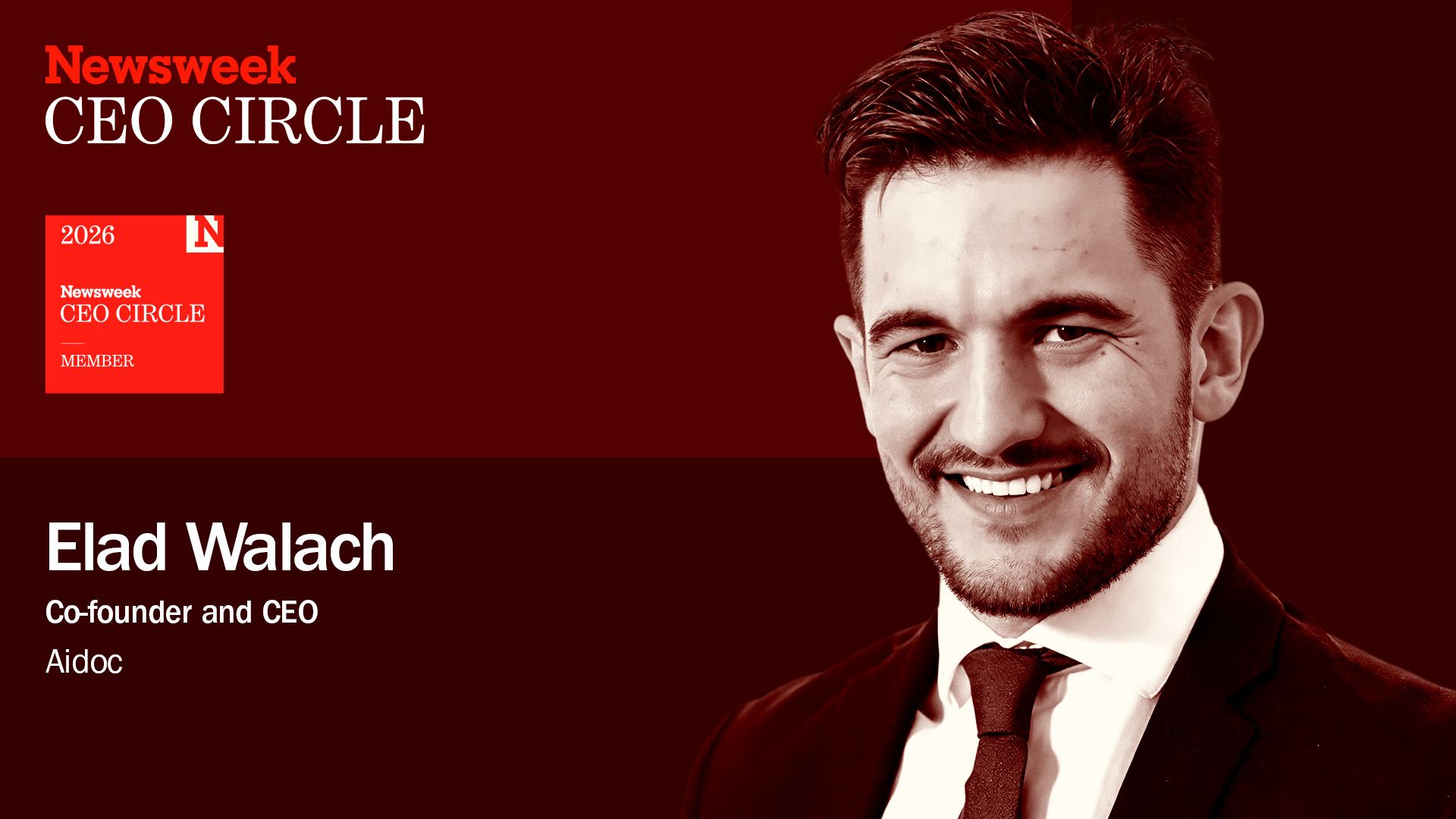
Elad Walach is the co-founder and CEO of Aidoc, a clinical AI platform headquartered in New York and Tel Aviv.
What are the core elements of the DNA at Aidoc?
The first thing is that we truly care about safety, quality and patient care. It's very demanding work running a startup company into an explosive growth stage. The second thing is creative effectiveness. We're effectively very relentless in what we do because we have the sense of urgency and we understand these are some of the more difficult problems of humanity right now.
For example, how to build safe enough models integrated into the workflow. We recognize that it'll not be an easy problem to solve, it requires the best of us. We also recognize that we have a lot to learn. We led with humility and understanding; we can bring the tech, but we need the partnership and support of the whole health care ecosystem.
How have foundation models changed health care AI and why does this matter to patients?
The problem of clinical AI that actually changes care decisions is that it has to be very accurate. To augment clinicians, you have to be as good as clinicians. But to achieve that, in the past we had to have a big tradeoff. You could do it, but only for one disease at a time. As you know, we have thousands of different diseases. These foundation models are a very big undertaking, trained on millions of patient records with hundreds of millions of dollars for investments.
But once you get this foundation model, it is both very accurate and very comprehensive. They allow us to reach a world where we can have an AI supporting every care decision. Imagine a world where every care encounter will have this AI oversight to ensure every diagnostic decision is correctly identified, properly prioritized and properly coordinated.
Aidoc started in 2016 before foundation models existed. What problems were you trying to solve then? How did that path lead you to build care?
Me and the co-founders all had a shared passion for medicine. For me, it was a family story. My aunt was in a bus accident and when she reached the hospital, she was misdiagnosed and unfortunately passed away due to this misdiagnosis.
We realize physicians are incredible people. They are trying to integrate so much information; they need all the help they can get. Medicine is so complex and that was the rationale behind inventing Aidoc as a whole.
We did the leap to CARE when we realized that you can't solve the problem of this AI in every care encounter without having the technology shift that allows us to really cover every disease at once.
With AI becoming more and more capable, will AI ever replace doctors?
I know a lot of people are constantly thinking about the question of the nature of work and physician work. I really don't think that's going to be the case. I do think it might change the nature of work. We will see them doing less and less of the mundane work.
In medicine, we often talk about top of license work. If there is a top of license work, there is also a bottom of license work – the thing you didn't go to medical school or residency for. That is the job that I think AI can take on and help bring back the joy of being your diagnostic aide.
Health care is one of the most difficult industries to deploy a foundational model. What makes it so hard?
First, health care has a very bad last mile problem. It has its own dedicated system with its own dedicated interfaces. Integrating into the workflow is extremely hard. You need to integrate into dozens of systems and the underlying data you have keeps changing all the time. We call it data drift as opposed to model drift. You could have the best model in the world, but the underlying data changes all the time. You have new protocols, you have new scanners and you have new hospitals. Everything changes all the time daily in health care.
The second thing is that safety and quality matter a lot more. We're talking about models that need to reach the next level of accuracy in a way that frontier models don't need to. That is a very high bar. Clinicians are really good. I think these two problems make health care resistant to foundational models when talking about actual care delivery.
What does raising the bar actually look like?
First, we will keep investing in developing more and more accurate models and we will be relentless about it. We actually didn't release our foundational model into the market before we were able to hit a 10x reduction in false positive rate compared to all models.
The second thing is, it's not just about the models, it's about everything else. We have dozens of people within Aidoc whose job is AI safety. They monitor the AI, track its performance and review cases. They come from all walks of life – from clinicians to data scientists – to ensure that the model actually works as good as in production.
And what we learned is that the model itself is not stable enough. You need to have the humans helping ensure the accuracy stays consistent. And that is very core to our beliefs. If you invest in these two things, you will get really good models that maintain that accuracy in production.
In three to five years, what does all this mean for clinicians, hospitals and patients?
I think we're three to five years away from clinical AI being ubiquitous. I think in five years, we'll look back, and we'll think, 'what do you mean clinicians just diagnose patients without using any type of diagnostic support?'
The momentum we're seeing in terms of adoption of these tools would mean we're able to tackle a lot of the big problems of diagnostics. We'll have much more access, we will have much more accuracy and we will have our incredible clinicians being superhuman because they now have the tools to diagnose faster, better and in a more timely fashion.
What is the global impact of the work you're doing?
I feel very privileged to be in healthcare at the moment because I feel we're at the precipice of the largest step function in medicine humanity has seen for generations. We've tried to improve the quality of care; we've tried to improve access and capacity; we were just capped because we're only human, and we only have a limited number of humans. We're in a massive shortage. Finally, we're able to blow past that with this new wave of clinical AI technologies. I think this will have global implications for healthcare because we would have the ability for diagnostics to be 10 times as fast and with higher quality.
Elad Walach is a member of the Newsweek CEO Circle, an invite-only executive community of subscribers.
 Visit our rankings portal
Back To Top


U.S.WorldScienceHealthRankingsOpinionEntertainmentFact CheckMy TurnEducationEventsSportsPodcastsBetter PlanetBetter WorkplacesMightierAutosNewslettersUnconventionalVantageExpertsLeadershipDev Pragad
Trending
Israel at War Vladimir Putin Russia-Ukraine War Donald Trump
Subscriptions
Membership Monthly $4.99 Membership Yearly $49.00 Membership+Print Monthly $9.99 Membership+Print Yearly $99
Newsletters in your inbox See all
The Bulletin (Daily)See Sample
The Gist of It (Daily)
Geoscape (Twice a Week)
The 1600 (Daily)
Inside Trump Policy (Weekly)
Newsweek AI (Weekly)
Sports Daily (Daily)
The Josh Hammer Report (Weekly)See Sample
For The Culture (Three Times a Week)See Sample
Discoveries (3 Times a Week)
Like & Subscribe (Daily)
Breaking News (As it Breaks)
The Debate (Twice a Week)
Pawsitively (Daily)
Better Planet (Weekly)
The Good Life (Weekly)
Newsweek Pulse (2x3 Times a Month)
Sign up now
You can unsubscribe at any time. By signing up you are agreeing to our Terms of Service and Privacy Policy
In The Magazine  September 19
2025 Issue
Company
About UsMastheadDiversityAnnouncementsArchivePolicies and StandardsMission StatementLeadershipNewslettersPress Center
Editions:
Contact
AdvertiseCareersContact UsCorrections
Terms of Use
Cookie PolicyCopyrightPrivacy PolicyTerms & ConditionsTerms of Sale Privacy Settings
© 2026 NEWSWEEK DIGITAL LLC