- U.S.
- World
- Science
- Health
- Life
- Rankings
- Opinion
- Entertainment
- Fact Check
- My Turn
- Education
- EventsSportsPodcastsBetter PlanetBetter WorkplacesMightierAutosNewslettersUnconventionalVantageExpertsLeadershipDev Pragad
- Subscribe

- Login
×
Subscribe Login
- U.S.
- World
- Science
- Health
- Life
- Rankings
- Opinion
- Entertainment
- Fact Check
- My Turn
- Education
- Events
- Sports
- Podcasts
- Better Planet
- Better Workplaces
- Mightier
- Autos
- Newsletters
- Unconventional
- Vantage
- Experts
- Leadership
- Dev Pragad
Barbara Collins
Home > Rankings Portal
Share
Share on Facebook Share on Twitter Share on LinkedInShare on RedditShare on Flipboard Share via Email Comments
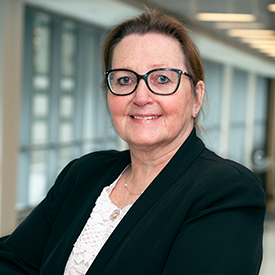
Barbara Collins
Humber River Health
President & CEO


Company Info
Humber River Health
1235 Wilson Avenue
Toronto Ontario M3M 0B2
About
Barbara Collins, president and CEO of Toronto's Humber River Health, has led the organization since July 2016. Over the last decade of her leadership, the hospital has introduced multiple cutting-edge technologies, such as robotic hip and knee surgeries, which allow patients to go home the day of surgery.
“People come to us from around the world to understand the different robotic surgery procedures, to learn the procedure and to practice with our surgeons,” she explains. “It's important if we have an innovation that's successful for us to share that.”
Newsweek CEO Circle, an exclusive membership program, brings together CEOs, executives and founders to share their insights, navigate current and future challenges and drive meaningful change.
Learn more about Barbara's experience in the below interview.
Education
- Master's Degree
Masters of Business Administration
Queen’s University
Awards & Certifications
- As COO, Barbara led the design, construction, and activation of the Wilson site, North America’s first fully digital hospital, in October 2015.
- She was an integral part of developing and implementing Humber River Health’s Command Centre in November 2017, a first in Canada and second in the world.
- Led Humber through one of the hardest-hit communities during the COVID-19 pandemic without hallway healthcare and facilitated the vaccination of more than 400,000 individuals.
- Under her leadership, Humber established two Reactivation Care Centres, a 320-bed long-term care facility, the Schulich Family Medicine Teaching Unit, and the launch of Humber’s Research Institute.
- Humber River Health was accredited with Exemplary Standing, achieving 99.9% of Accreditation Canada’s standards.
- Humber was recognized by Forbes as one of Canada’s Best Employers for Diversity.
- For the second consecutive year in 2024, Humber was named one of Greater Toronto’s Top Employers, announced by Medicorp Canada Inc.
Philanthropic Endeavors
- Barbara is an advocate for diversity, equity, and inclusion, reflected in her support for Anti-Black Racism initiatives at Humber.
- She has also been involved in launching the Measuring Health Equity Survey, which helps identify and address inequities in healthcare delivery.
- Furthermore, she supports women’s health through the Women’s Centre of Excellence (WCOE) at Humber.
Links to Rankings during tenure
CLOSE X
Barbara Collins, president and CEO of Toronto's Humber River Health, started her career as a nurse, joining in 1999. Under her leadership, the hospital has developed cutting-edge technical systems for monitoring patients in the hospital—and is working on ways to reach patients before they need to be admitted.
Through community care and in-home monitoring, Collins hopes to alleviate the pressures of understaffing and too few beds in the hospital by meeting people where they are.
Is there a moment in your upbringing that really shaped your decision to pursue a career in health care?
I had a sister who had major back surgery as a teenager, and I would go down to the hospital for sick children every day and help look after her. I think that really sparked my interest in health care—being around health care providers and watching them.
I remember one day when she was really sick, and I thought, "Wow, this is terrible, something awful is going to happen," and the awful didn't happen because people responded and she got better, and I thought, That's a really neat thing to watch people be very sick and then watch them be very better.
Your career spans 48 years, including managing every department in a hospital before entering leadership. What would you say motivated you to pursue a leadership role?
It probably happened very early on in my career, because I always had an opinion. I was committed, and I was a manager within five years of graduating from nursing school.
Management is an opportunity to show people the importance of communication and the importance of being authentic. Authenticity is really important and when you're in a leadership role, you have an opportunity to demonstrate that and what you hope is that others learn that from you and that they mirror the same.
Now, as a CEO, how do you define success at the end of the day, particularly in balancing technological advancements with compassionate care?
I truly believe the reason we—engaged staff, physicians and volunteers—are here is for two things. If you engage people and you have them committed to the corporation, then they're going to live your values, and those values are going to translate to great patient care. Our values are compassion, professionalism and respect.
And our patient satisfaction question, when we say to people, "Would you recommend Humber River Health to your friends and family?" 87 percent of the people we ask say they would.
As leaders, we need to be authentic, we need to be out there. Hospitals are open 24/7. It's not a Monday-to-Friday, 9-5 role. You need to be here available after hours. You need to be part of your organization. And I think as a leader, that's one of the most important things we can do.
Humber River Health serves a diverse community with significant barriers to care. What has been your biggest challenge as a leader and how did you navigate it?
We have a very diverse community and, you're right, their challenges to care are quite significant. We have a huge new immigrant population. We have people that are unable to find jobs because of their level of education or other experiences in life. And it changes the way you provide care.
It's not great to say, "Go to the gym and work out," because you probably can't afford a gym membership. "Go home and eat healthy food." Well, if you can't afford healthy food—some of our patients can't even afford their medications. Many of our people don't even have OHIP coverage [Ontario Health Insurance Plan, which covers what's medically necessary].
As a hospital, we have learned to come together with our community providers. We call it the Northwest Toronto Ontario Health Team, of which Humber is a very active member and I'm a co-chair.
Building trust with patients is critical. How has Humber River Health fostered trust, especially with underserved populations?
The way you build trust is how you treat people. You don't have to look at the person as having less than the other person. They may not have a job; they may not have income. That's not our business to point that out to them. It's not our business to go and tell them they should.
It's our business to understand what their situation is, and to treat them kindly. And I think we do well at Humber.
In fact, health care and social care come together, right? We've recently taken some of our space at one of our other sites and opened a hub with a number of partner organizations.
Humber built it. We've provided the space free of charge. Teams come together and they provide not only health care—they'll help you fill out immigration papers. They'll help you find a job, if you need to. If day care is a problem and you can't go to work, they'll help you.
They'll also check your diabetes. They'll check your blood pressure. They'll do health teaching. Health and social services have come together. It's called the HUB@2115. It's been a great initiative to bring partners to look not only at health care, but social care because the two of them are linked.
In 2019, you developed the hospital's command center and its safety tile program, which shows a patient's blood work or vital signs. Data downloads from the patient's record and a screen will tell hospital employees if something about that patient indicates a patient is deteriorating.
Can you share a patient story that reinforced the importance of innovations like your command center or automated systems?
I have had patients' families say to me, "We were in the room, my daughter wasn't feeling well, my mother wasn't feeling well. We were going to call a nurse and suddenly a doctor and two nurses came in the room. They started to do things, and we didn't even know who called them."
That's because the command center works the way it should work. It alerts that a patient's condition is deteriorating. We will call the staff and send help. Our results have been incredible from that. It creates a safer environment for patient care.
Our hospital harm is less than one-third the rate of other hospitals in Ontario and across Canada because of that.
Under your leadership, Humber River Health has become a model for innovation and safety. Can you share a story about an accomplishment that you're particularly proud of?
When you're in a technologically advanced organization, wherever you can save patients having to be admitted to a hospital, you're going to save a little bit of money in care, and you're going to save beds to treat sick patients.
We were the first hospital in Canada to introduce robotic hips and knees, which helps you place the hip and knee well. With that device, with the commitment of our surgeons and our anesthetist to pain management, our patients go home the day of surgery. And we were the first ones to do that, which has saved thousands of bed days.
The process is so streamlined that, normally in a hospital, you can do about three or four hips or knees in a day. Our team is able to do 12.
Humber River Health has a reputation for being a first mover in health care. Would you say that your institution has helped move the needle for Canadian health care in general?
I think we've moved the needle in health care in many parts of the world. We have been all over the world talking about our command center. We have been all over the world talking about our safety tile and our safety records because every country grapples with this.
Also, people come to us from around the world to understand the different robotic surgery procedures, to learn the procedure and to practice with our surgeons. It's important if we have an innovation that's successful for us to share that.
All hospitals are caring for the same human body, right? So let's share our knowledge, because if we build upon each other's elements of knowledge, then we will move health care nearer.
Humber River Health is known as North America's first fully digital hospital. How has integrating technologies like AI and automation transformed care delivery for your patients?
Care delivery for our patients has been transformed by predictive analytics and AI, and it is because we are able to observe what is going on with our patients and our command center.
In the process of doing that, not only is our care much safer than anyone else, but we have decreased the number of cardiac arrests in the hospital by 40 percent.
But the other thing to remember is most of what we pay for in hospitals is staff and physicians walking around to deliver care. I don't want the nurse to have to write data on a piece of paper, go back to the nursing station and chart it. That machine already collected the data, let it automatically download it to the patient record, which it does at Humber, and then let it create a result.
It may not be perfect, but it is better than the technology we had a while ago.
What do you see as the biggest opportunity in the health care industry today and how is Humber River Health leading the way in areas like digital transformation and equity?
We are all short of health care workers. And Humber actually is very fortunate. We are not that short of them. But we will never have enough health care workers in the future to deliver the care we need. The population is aging. Most of your health care is in the last few years of your life.
And the younger population doesn't want to go into health care as we did 48 years ago. So what's important for us is to look at how technology can replace the employees that we're not going to have enough of, but better, how can we give a better work-life balance to our staff and our physicians, and even to the patients, so that people want to enter the health care journey.
It ends up being a much better life balance. When we talk to our staff, people who have done their training at Humber or have come back to Humber say they've come back because it feels safer here, they feel more protected, and they like the technology.
What's an exciting initiative currently underway at Humber River Health and what is your vision for the hospital's future impact on health care in Canada and beyond?
We are now going to what we call phase three of our command center, and a little bit of work is already being done in this space by others, but we want to be able to care for people in their homes—everybody can't be admitted to hospitals, a shortage of long-term care beds. It's not for everybody.
What we're developing is the patient, particularly the elderly and those who live alone, stays in their home, but we monitor them in there just as we monitor within the hospital.
We can check in on them through technology. We also have a closed-loop communication system we're developing so that if there's a challenge with the patient, we can reach out to the prescribed family members or the primary care physician, and maybe we can get them help and intervention earlier in the home.
Let's be able to communicate with them. And let them know that just as we're monitoring our patients that are in the hospital, if you need monitoring, there's a team here looking after you and getting you help.
Barbara Collins is a member of the Newsweek CEO Circle, an invite-only executive community of subscribers.
 Visit our rankings portal
Back To Top


U.S.WorldScienceHealthRankingsOpinionEntertainmentFact CheckMy TurnEducationEventsSportsPodcastsBetter PlanetBetter WorkplacesMightierAutosNewslettersUnconventionalVantageExpertsLeadershipDev Pragad
Trending
Israel at War Vladimir Putin Russia-Ukraine War Donald Trump
Subscriptions
Membership Monthly $4.99 Membership Yearly $49.00 Membership+Print Monthly $9.99 Membership+Print Yearly $99
Newsletters in your inbox See all
The Bulletin (Daily)See Sample
The Gist of It (Daily)
Geoscape (Twice a Week)
The 1600 (Daily)
Inside Trump Policy (Weekly)
Newsweek AI (Weekly)
Sports Daily (Daily)
The Josh Hammer Report (Weekly)See Sample
For The Culture (Three Times a Week)See Sample
Discoveries (3 Times a Week)
Like & Subscribe (Daily)
Breaking News (As it Breaks)
The Debate (Twice a Week)
Pawsitively (Daily)
Better Planet (Weekly)
The Good Life (Weekly)
Newsweek Pulse (2x3 Times a Month)
Sign up now
You can unsubscribe at any time. By signing up you are agreeing to our Terms of Service and Privacy Policy
In The Magazine  September 19
2025 Issue
Company
About UsMastheadDiversityAnnouncementsArchivePolicies and StandardsMission StatementLeadershipNewslettersPress Center
Editions:
Contact
AdvertiseCareersContact UsCorrections
Terms of Use
Cookie PolicyCopyrightPrivacy PolicyTerms & ConditionsTerms of Sale Privacy Settings
© 2026 NEWSWEEK DIGITAL LLC